

The Expectation Gap Is Real and Growing
Something fundamental has shifted in what citizens expect from their government. Accustomed to instant digital transactions across banking, food delivery, and healthcare services, people are no longer willing to accept the weeks-long timelines, paper-laden processes, and phone-call-dependent workflows that still define much of public service delivery. The contrast has become a source of not just inconvenience, but institutional distrust.
The data is unambiguous. McKinsey research1 finds that Americans rate government services last in customer satisfaction compared to nine private sector industries. Yet the same research reveals the upside: satisfied citizens are nine times more likely to trust the agencies that serve them and nine times more likely to believe those agencies are achieving their mission. The gap is real, and so is the opportunity to close it through public sector digital transformation.
This gap has real consequences. Trust in government institutions correlates directly with the quality of constituent experiences. Agencies that fail to modernize are not only inefficient; they risk weakening the trust they are meant to uphold.
Why Modernization Is Hard and Why Most Efforts Fall Short
It would be easy to assume that modernization is simply a matter of replacing old software with new software. But that assumption is exactly why many public sector transformation programs stall or fail. Technology is rarely the bottleneck. Process complexity, built over years of fragmented workflows and inconsistent standards, is often the real barrier.
Across government agencies, several structural challenges make government IT modernization difficult:
- Siloed operations: Departments built around distinct functions often have no shared data, no consistent process standards, and no unified view of citizen interactions. A single permit application may touch a dozen different systems and teams that do not communicate effectively.
- Legacy technology: Legacy systems remain a primary barrier to adopting and implementing digital solutions, creating friction across workflows and limiting scalability.
- The ‘digitize first’ trap: Many agencies begin modernization by converting paper forms to digital PDFs and stop there. The result is digitized dysfunction: the same broken workflow, just faster. Without redesigning the underlying process, the citizen experience remains poor and staff productivity gains are negligible.
- Funding and talent constraints: Public agencies compete against the private sector for digital talent and often struggle to compete. Limited IT budgets mean that even well-intentioned modernization programs are often under-resourced, leading to partial implementations that create new silos rather than resolving old ones.
The consequence: government agencies that have historically operated on timelines measured in fiscal years are now facing a public that measures acceptable response times in minutes.
The Shift That Changes Everything: Platform Over Point Solution
The agencies making meaningful progress share a common strategic orientation: they are not buying their way out of complexity with point solutions. They are building scalable, platform-based digital foundations that can grow with their needs and extend across functions.
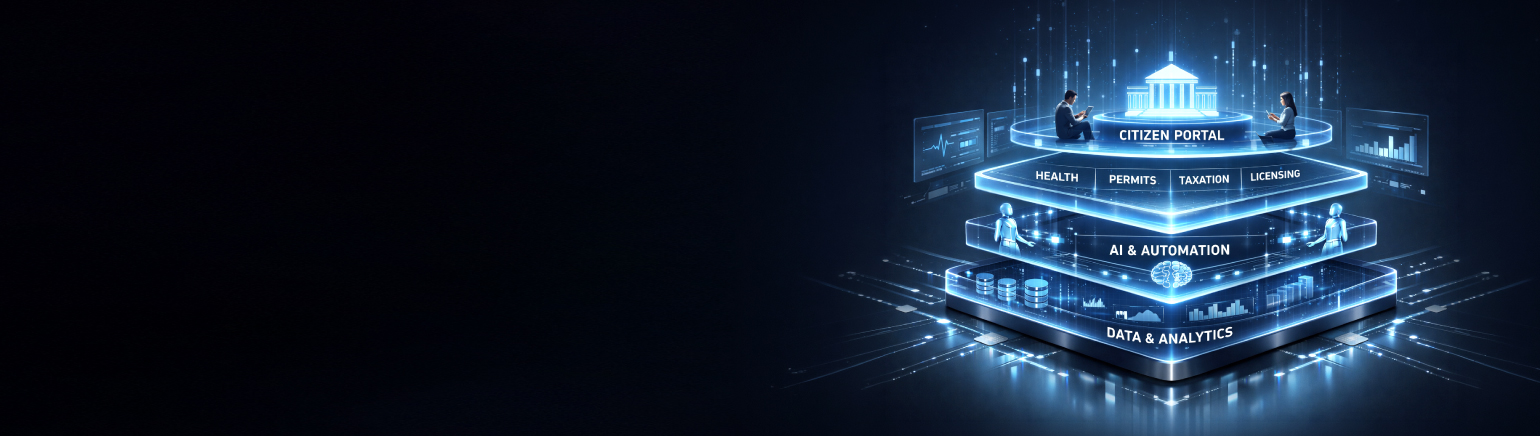
This approach focused on platform-based transformation is gaining traction precisely because it compounds in value over time. A digital platform built to streamline permitting today can be extended tomorrow to manage inspections, case reviews, licensing, and citizen communications without requiring complete redesign. This model also dramatically accelerates time-to-value for future capabilities.
The move to platform-based modernization also creates the right foundation for what comes next. AI-powered service agents, natural language interfaces, and predictive analytics are no longer speculative futures. They are deployable capabilities. But they can only deliver value in agencies that have already built clean, connected, digital data foundations. Agencies that remain paper-based or siloed will be unable to unlock the next generation of efficiency and citizen experience gains.
Gartner’s latest prediction2 signals just how fast this is moving: by 2029, 60% of government agencies globally will leverage AI agents to automate over half of citizen transactional interactions compared to less than 10% in 2025. And at least 80% of governments will deploy AI agents to automate routine decision-making by 20283. The agencies that will be best positioned to benefit from these trends are those that start building digital infrastructure today.
From Paper to Platform: A Public Health Modernization Story
The principles above are not theoretical. Consider what one U.S. East Coast state Department of Public Health achieved when it decided to rethink not just digitize its permit and inspections process.
The agency’s starting point was familiar to most public sector leaders: permit applications handled through mail and email threads, printed forms requiring physical delivery, hundreds of staff hours spent weekly sorting and routing documents, and critical data living in unsupported databases and manual spreadsheets. Processing times stretched to weeks. Siloed regional teams produced inconsistent outcomes for citizens and businesses seeking public health compliance approvals.
What began as a request to convert PDFs into online forms evolved into something more strategically significant. Rather than simply digitizing the existing process, the modernization effort re-examined the entire workflow by harmonizing fragmented regional operations, redesigning the citizen journey from end to end, and building on a scalable cloud platform.
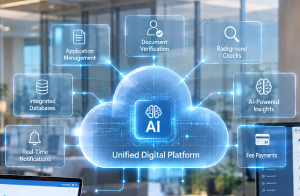
The resulting solution delivered a public-facing self-service portal with milestone-based automated workflows, real-time payment integration, secure document upload, and automated permit generation all connected to a unified internal operations dashboard for staff. The outcome: a process that once took weeks now takes minutes. Citizens can track their applications in real time, make payments online, and receive permits digitally without a phone call or office visit. Staff, freed from paper administration, can now focus on inspections, compliance work, and direct constituent support. And critically, the platform is designed to extend across additional public health functions and agency programs with each new capability building on a proven, reusable foundation.
This is what effective public sector modernization looks like: not the automation of old problems, but the redesign of how government serves people through a platform built to scale.
What Forward-Looking Agencies Are Doing Differently
The agencies making the most progress in 2026 are not necessarily the best-funded or the most technically sophisticated. They are the ones with the clearest vision and the discipline to execute against it. Several distinguishing behaviors set them apart:
- They redesign before they digitize. Process harmonization is treated as the work itself, not a precursor to the real work. Siloed workflows are mapped, rationalized, and redesigned around citizen needs before a single line of code is written.
- They invest in the citizen journey, not just the back end. The 2025 State of Digital Government report found an 80% increase in digital form completions in the past year alone, showing that citizens adopt self-service when it is designed effectively. The experience layer matters as much as if not more than the infrastructure layer.
- They build for extensibility. Platform choices are evaluated not just for what they can do today, but for what capabilities they can unlock tomorrow including AI agents, predictive analytics, multi-channel citizen engagement, cross-agency data sharing.
- They measure trust, not just throughput. The most progressive agencies are tracking citizen satisfaction and institutional trust as primary transformation metrics understanding that operational efficiency and public confidence are closely linked.
The window for differentiation is narrowing. Citizen expectations are continuing to rise rapidly. And with AI-powered public services moving from pilot to production across governments worldwide, the gap between early movers and laggards will widen significantly.
The Time Is Now
Public sector modernization has too often been treated as a long-term aspiration pursued only when conditions appear favorable. But the conditions that made delay acceptable have changed. Citizens are less patient. Technology is more accessible. And the platforms available today allow agencies to move faster, at lower risk, than at any previous point in the history of government IT.
The question for public sector leaders is no longer whether to modernize. It is whether to do so in a way that builds institutional momentum or simply manages immediate pressure. Agencies that invest in harmonized, platform-based, citizen-centered transformation now will not just serve people better today. They will be the agencies positioned to lead as AI, automation, and new digital capabilities reshape what government can be.
That future is already being built. The agencies that understand this and act accordingly will define what public service means for the next generation. With deep expertise in public sector digital transformation, HTC helps agencies modernize legacy systems, enable citizen-centric digital services, and build scalable platforms for AI-driven outcomes. Build the digital foundation your agency can stand on and serve with confidence.
References:
1https://www.mckinsey.com/industries/public-sector/our-insights/great-expectations-how-us-government-agencies-can-meet-public-demand-for-better-service
2https://www.gartner.com/en/newsroom/press-releases/2025-09-09-gartner-reveals-top-technologies-shaping-government-ai-adoption
3https://www.gartner.com/en/newsroom/press-releases/2026-03-17-gartner-predicts-at-least-80-percent-of-governments-will-deploy-ai-agents-to-automate-routine-decision-making-by-2028