



Introduction
Infrastructure as Code (IaC) has reshaped how organizations provision, manage, and scale IT infrastructure. By defining infrastructure in code, enterprises gain automation, consistency across environments, and on-demand scalability. Today, IaC isn’t just a DevOps tool—it’s a strategic enabler for digital transformation. This blog explores its foundational principles, top tools, use cases, and how enterprises are using IaC to deliver business value.
What is Infrastructure as Code (IaC)?
Infrastructure as Code (IaC) is the practice of managing and provisioning computing infrastructure—such as servers, networks, databases, and firewalls—via machine-readable configuration files, rather than relying on manual setup or GUI-based tools. This approach brings version control, testability, and repeatability to infrastructure management, applying software engineering best practices such as CI/CD, testing, and modularization to infrastructure.
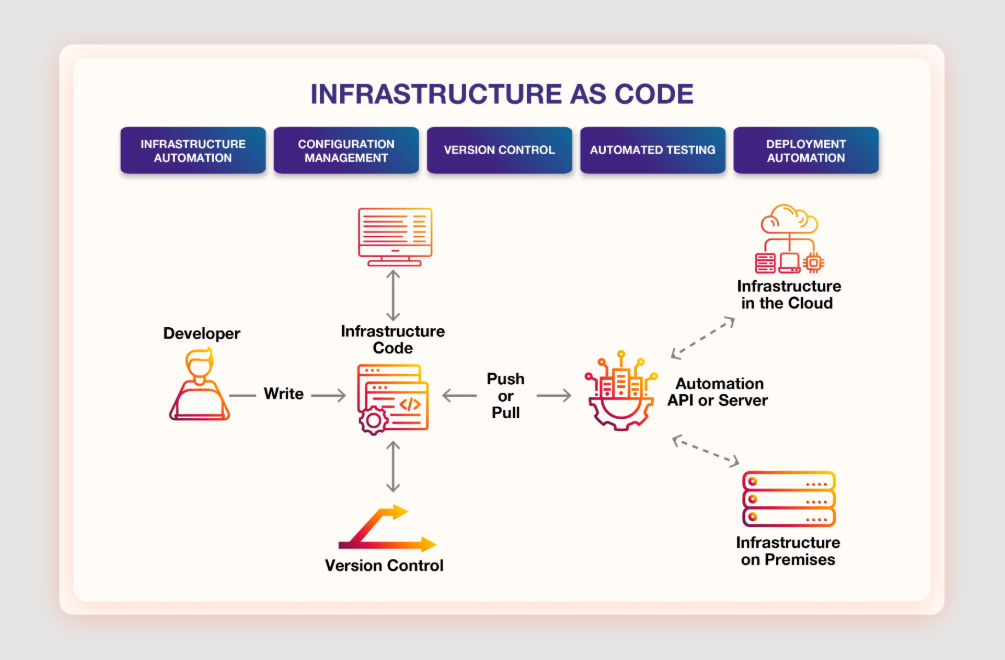
When and how to use Infrastructure as Code?
IaC is applicable across the software development lifecycle (SDLC) phases in the following scenarios:
- Environment provisioning: IaC enables consistent and repeatable provisioning of development, testing, staging, and production environments. By ensuring identical configurations, it minimizes the risk of inconsistencies that often lead to bugs or deployment issues.
- Application deployment: Use IaC to automate the deployment of applications and infrastructure components—such as servers, networks, middleware, and application code. IaC sets up deployment pipelines that apply configuration changes automatically whenever new code is pushed to version control.
- Scalability and elasticity: IaC allows dynamic resizing of infrastructure resources by scaling up or down based on demand. Auto-scaling mechanisms can automatically add or remove servers, containers, or other resources in response to traffic fluctuations.
- Disaster recovery and high availability: Use Infrastructure as Code (IAC) together with a strategy based on the creation of redundant and resilient infrastructure configurations that have minimum downtime when failure or disasters happen. Describe failover options, backup strategies and recovery plans in the infrastructure code for business continuity.
- Compliance and security: Apply IaC to ensure uniform security policies, compliance standards, and best practices across the infrastructure. Define security groups, access controls, encryption settings, and auditing mechanisms in the infrastructure code to ensure regulatory alignment in data protection.
- Infrastructure as a Service (IaaS) and cloud migration: Whether moving to the cloud or managing IaaS platforms like AWS, Azure, or GCP, Infrastructure as Code (IaC) simplifies the process easier by codifying infrastructure requirements, resources, and dependencies for automated, manageable deployment.
- Collaboration and documentation: IaC enhances team collaboration and serves as living documentation. Storing code in version control (e.g., Git) allows teams to review, contribute, and track infrastructure changes—making onboarding and system understanding easier.
Top Infrastructure as Code (IaC) Tools & Platforms
Terraform
- Multi-cloud provisioning with a declarative language.
- Supports AWS, Azure, GCP, Kubernetes, and more.
AWS CloudFormation
- AWS-native tool using JSON/YAML templates.
- Supports stack updates, rollback, and drift detection.
Azure Resource Manager (ARM) Templates
- Automates Azure resource deployments via JSON files.
- Ensures consistency across Azure services.
Google Cloud Deployment Manager
- YAML/Jinja2 templates for GCP resource automation.
- Supports Compute Engine, BigQuery, Kubernetes, etc.
Ansible
- YAML-based playbooks for provisioning, config management, and orchestration.
- Compatible with cloud, virtualization, and networking platforms.
Chef
- DSL-based “recipes” for configuration management.
- Ideal for complex, idempotent infrastructure setups.
Puppet
- Declarative language for centralized config management.
- Suitable for large-scale deployments with reporting features.
Key Use Cases for IaC Implementation
Multi-Environment Provisioning
Automatically create consistent development, staging, and production environments.
Impact: Eliminates environment drift and accelerates application development cycles.
Automated Disaster Recovery (DR)
Define disaster recovery infrastructure in code for rapid redeployment.
Impact: Reduces recovery time objectives (RTO) and ensures business continuity with minimal manual effort.
Auto-Scaling Infrastructure
Deploy scalable cloud resources that automatically adjust based on demand.
Impact: Optimizes costs and improves system performance during usage spikes.
Strategic Roadmap: Implementing IaC for Business Outcomes
Successfully implementing Infrastructure as Code requires more than tool selection—it demands a comprehensive transformation strategy.
1. Discovery & Assessment
- Audit existing infrastructure and manual provisioning processes.
- Identify automation opportunities and technical debt.
2. Tool Selection & Capability Building
- Select tools aligned with your cloud stack, team skillsets, and use cases.
- Upskill teams in CI/CD, version control, and IaC scripting.
3. Pilot & Phased Rollout
- Begin with non-critical workloads to build confidence.
- Gradually expand to core production systems with rollback capabilities.
4. Ecosystem Integration
- Integrate IaC with tools like Git, Jenkins, Kubernetes, Helm, and Vault.
- Adopt complementary technologies: GitOps, Serverless, Containerization, and AIOps.
5. Governance & Continuous Improvement
- Establish code reviews, automated testing, and policy-as-code.
- Monitor performance, cost efficiency, and drift detection using observability tools.
Real-World Applications of Infrastructure as Code (IaC)
Enterprises today are embedding IaC deeply into their cloud, DevOps, and infrastructure modernization initiatives to achieve agility, scalability, and control. The following use cases highlight how organizations are maximizing IaC’s potential:
1. Rapid and Repeatable Environment Provisioning
IaC modules are used to automate the provisioning of cloud and on-prem environments across development, testing, and production. This eliminates manual setup, ensures configuration consistency, and accelerates deployment timelines.
2. Security and Compliance by Design
Security controls, access policies, and compliance frameworks such as HIPAA, PCI, and GDPR are embedded directly into IaC templates. Policy-as-code and validation pipelines ensure infrastructure governance from the outset.
3. Cloud Migrations and Landing Zone Automation
IaC enables the creation of standardized landing zones across AWS, Azure, and GCP cloud environments- covering VPCs, subnets, firewalls, identity services, and monitoring—all defined as code and deployed reliably across regions.
4. Scalable & Elastic Infrastructure
Auto-scaling groups, load balancers, and dynamic resource provisioning are configured through IaC, allowing infrastructure to adapt automatically to workload demands while optimizing cost and performance.
5. Disaster Recovery and Business Continuity
Disaster recovery environments, replication policies, and failover strategies are codified for fast, reliable restoration. This minimizes downtime and supports resilient operations.
6. DevSecOps Enablement
IaC pipelines are integrated into DevOps (CI/CD) workflows using tools like Jenkins, Azure DevOps, and GitHub Actions. Security scans, policy checks, and deployment validations are automated end-to-end.
7. Observability and Cost Optimization
Monitoring agents, logging frameworks, and tagging strategies are provisioned via IaC to ensure real-time observability and accurate cost tracking across environments.
Business Value Delivered Through IaC
- Speed to Deploy – Standardized, reusable templates significantly reduce provisioning time—from weeks to minutes.
- Operational Consistency – Uniform configurations across environments minimize outages, reduce troubleshooting, and eliminate drift.
- Security Assurance – Security policies embedded in code reduce vulnerabilities and support audit-readiness from day one.
- Cloud Cost Control – Automated provisioning ensures optimal resource utilization and prevents unnecessary cloud sprawl.
- Business Agility – Infrastructure scales dynamically in response to demand, enabling rapid innovation and faster time-to-market.
Conclusion
Infrastructure as Code is now essential to building scalable, agile, and resilient IT operations. It enables automation, consistency, and compliance—empowering DevOps teams to deliver faster and smarter.
With deep cloud expertise and an automation-first approach, HTC helps enterprises adopt and scale IaC practices—driving real outcomes in a cloud-native world.