



SCSB: The Backbone of Shared Library Collections
Every year, millions of library items sit locked away in storage—valuable resources hidden from the readers who need them most. The Shared Collection Service Bus (SCSB) is changing that reality, turning scattered catalogs into one living, breathing collection.
In today’s world of interconnected libraries and digital resources, seamless access to shared collections is more important than ever. The Shared Collection Service Bus (SCSB) stands at the heart of this transformation, enabling partner libraries to collaborate, share, and manage their vast collections efficiently.
What is SCSB (Shared Collection Service Bus)?
SCSB (pronounced “scuzee-bee”) is a middleware platform designed to integrate the library systems of partner institutions with backend archival systems. Its primary goal is to allow libraries to store, manage, and share metadata about their collections, making it possible for users to borrow items not just from their own library, but also from partner institutions.
Why Was SCSB Needed?
For decades, libraries operated in silos. A student searching one catalog often had no idea that the same book sat just a mile away in another library’s collection. Traditional inter-library loan systems were slow, fragmented, and frustrating.. With the rise of large, shared storage facilities, there was a need for a unified system that could:
- Track items stored offsite but owned by different libraries
- Enable real-time item availability and request processing
- Standardize data exchange between diverse library systems
SCSB was developed to address these challenges, acting as a bridge between partner libraries and shared storage facilities.
How Does SCSB Work?
SCSB connects multiple library systems (such as university libraries, public libraries, etc.) with storage management systems using a combination of APIs (REST, SIP2, NCIP). It provides a real-time view of item availability, processes borrowing requests, and manages the flow of bibliographic and item data between systems.
Key Features
- Facilitate Discovery: The SCSB creates a unified index of all the items in the shared collection, making it possible for users to search across the catalogs of all partner libraries from a single interface. This means that when you search for a book in your library’s online catalog, you’re not just searching your library’s collection; you’re also searching for the collections of all the other libraries in the consortium.
- Real-time Availability: One of the biggest frustrations of traditional inter-library loans is not knowing whether an item is actually available. The SCSB solves this problem by providing real-time availability information. When you find an item you want to borrow, the SCSB checks its status in the lending library’s system to make sure it’s not checked out or on hold.
- Real-time Request Processing: Once you’ve found an available item, the SCSB makes it easy to request it. You can place a request directly from your own library’s discovery interface, and the SCSB will handle all the back-end communication between the two institutions.
- Real-time Status Reporting: The SCSB keeps you informed every step of the way. You can track the status of your request in real-time, from the moment it’s placed until the item is delivered to your library for pickup.
- Collection Management: The SCSB also includes tools for collection management, such as a matching algorithm that can identify duplicate copies of items across different libraries. This helps libraries to make informed decisions about which items to retain and which to withdraw, ensuring that the shared collection is as comprehensive and unique as possible.
- Cross-Institution Borrowing: Patrons may request materials from partner libraries, with the Shared Collection Service Bureau (SCSB) responsible for managing the routing and tracking of these items.
- Data Standardization: SCSB uses standardized formats (like SCSB XML and MARC XML) to ensure smooth data exchange.
- Centralized Metadata: All item information is stored centrally, making SCSB the single source of truth for shared collections.
The Benefits of SCSB: A Win-Win for Everyone
The Shared Collection Service Bus offers a wide range of benefits for everyone involved, from library users to librarians and developers.
For Library Users:
- Expanded Access to Resources: With SCSB, you have access to a much larger collection of materials than your own library could ever offer on its own. This means you’re more likely to find the books, journals, and other resources you need for your research, studies, or personal reading.
- Seamless Borrowing Experience: The SCSB makes borrowing from other libraries as easy as borrowing from your own. You can search, request, and track items from a single interface, without having to fill out complicated forms or navigate multiple library websites.
- Faster Turnaround Times: Because the SCSB automates many of the manual processes involved in inter-library loans, you can get the materials you need much faster than with traditional methods.
For Libraries and Librarians:
- Efficient Resource Sharing: The SCSB streamlines the process of sharing resources between libraries, reducing the time and effort required to fulfill inter-library loan requests.
- Collaborative Collection Development: By providing a unified view of the collections of all partner libraries, the SCSB enables them to coordinate their collection development efforts and build a more comprehensive and diverse shared collection.
- Improved Workflow and Automation: The SCSB automates many of the manual tasks involved in inter-library loans, freeing up library staff to focus on other important work.
For Developers and Technologists:
- Open-source Library Management Software: The SCSB is an open-source platform, which means that its code is freely available for other libraries and consortia to use and adapt to their own needs.
- API-driven Architecture: The SCSB is built on modern, API-driven architecture, which makes it easy to integrate with other library systems and to develop new applications and services on top of the platform.
The Architecture Behind SCSB
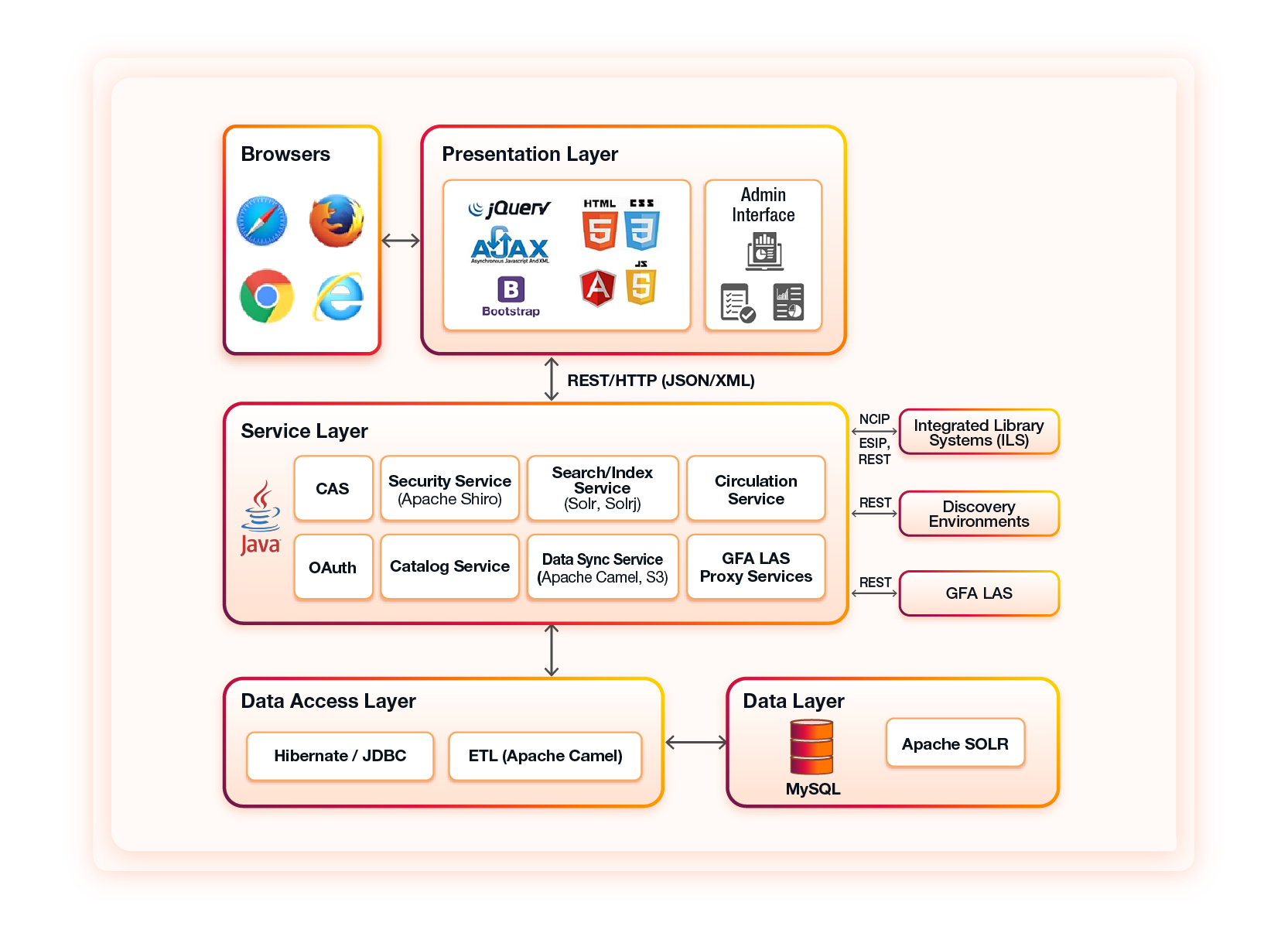
SCSB is built on a layered architecture, including:
- Presentation Layer: User interfaces developed using Angular JS, for staff and patrons.
- Authentication Layer: Supports CAS and OAuth 2.0 for secure access.
- Services Layer: Handles business logic and communication between systems.
- Search and Data Services Layer: Manages indexing, searching, and data transformation.
- Data Layer: Stores all metadata and transaction records.
Microservices further break down SCSB’s functionality, with dedicated services for circulation, data loading, authentication, and user interface management.
The Data Model
At its core, SCSB maintains detailed records of every item, including barcodes, customer codes, call numbers, and availability status. The system supports both initial data loads (for millions of existing items) and ongoing updates as new items are added or removed.
The Future of Shared Collections
The Shared Collection Service Bus is more than just a piece of technology; it’s a new way of thinking about library collections. In an increasingly digital world, the ability to share resources and collaborate with other institutions is more important than ever. The SCSB provides a model for how libraries can work together to create a more open and equitable system of access to information for everyone.
As more libraries and consortia adopt the SCSB and other similar technologies, we can expect to see a future where the boundaries between individual library collections begin to blur, and where users can access a truly global collection of knowledge with just a few clicks of a mouse.
Conclusion
The Shared Collection Service Bus is a powerful and innovative library resource sharing technology that is changing the game for libraries and library users alike. By making it easier than ever to share resources and collaborate with other institutions, the SCSB is helping to create a more open, equitable, and accessible world of information for everyone.
SCSB not only modernizes collection management but also ensures that libraries of all sizes can participate in global knowledge sharing.
So, the next time you’re searching for a book in your library’s online catalog, remember that you may be searching for a collection that is much larger and more diverse than you ever imagined, thanks to the power of the Shared Collection Service Bus.