

As enterprises scale across cloud-native environments, traditional monitoring tools struggle to keep up with the complexity, speed, and volume of modern infrastructure. This blog explores the limitations of legacy monitoring, the shift toward AI-driven observability, and how innovations like predictive monitoring, context-aware intelligence, and autonomous remediation are transforming cloud operations. It also outlines best practices, emerging trends, and the growing role of AI as a Service and cloud monitoring tools in enabling proactive, intelligent system performance.
Why Legacy Monitoring Can’t Keep Up with Cloud Chaos
As enterprises accelerate their migration to cloud platforms like Google Cloud Platform (GCP) and Microsoft Azure, the complexity of managing and monitoring cloud-native environments has grown exponentially. Traditional monitoring methods, while foundational, are struggling to keep pace with modern demands.
- Traditional cloud monitoring tools – and even many early cloud network monitoring software solutions- often rely on static thresholds and rule-based alerts.
- This results in a high volume of false positives, overwhelming operations teams with non-actionable alerts.
- As a result, critical incidents may be missed or delayed, increasing Mean Time to Resolution (MTTR).
- Over time, legacy tools struggle to deliver end-to-end visibility across distributed, containerized, and serverless architectures.
- Setting up and maintaining cloud monitoring configurations requires significant manual effort, especially in dynamic environments with frequent deployments.
- Engineers must manually tune thresholds, update dashboards, and correlate logs, metrics, and traces.
- As cloud environments scale, traditional monitoring tools struggle to keep up with the growing volume, velocity, and variety of telemetry data.
- The result: performance bottlenecks, rising operational costs, and declining monitoring quality.
AI as a Solution: Predictive, Adaptive, and Automated Cloud Monitoring
To overcome the limitations of traditional monitoring, organizations are increasingly turning to AI-driven observability platforms. These platforms leverage machine learning (ML), anomaly detection, and intelligent automation to transform how cloud environments are monitored and managed. Many of these platforms are offered as AI as a Service, enabling faster deployment and scalability.
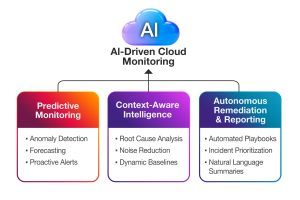
1. Predictive Monitoring
AI enables systems to anticipate issues before they affect users by analyzing both historical and real-time telemetry data, including logs, metrics, and traces.
Key capabilities include:
- Anomaly Detection: ML models learn normal behaviour patterns and detect deviations without relying on predefined thresholds.
- Forecasting: Time-series forecasting predicts resource exhaustion, traffic spikes, or performance degradation.
- Proactive Alerting: AI surfaces early warning signals instead of reactive alerts, helping reduce downtime and improve SLA compliance.
Examples:
- GCP Cloud Operations with ML: Google Cloud employs ML models to forecast potential failures across complex environments such as IoT, VMs, and microservices. It also offers explainable AI to clarify the root cause of anomalies and integrates GenAI (e.g., gcp-ops-bot) for natural language insights.
- Azure Monitor with AIOps: Azure’s Smart Detection identifies performance anomalies using telemetry from Application Insights. Its Dynamic Thresholds adjust automatically based on historical data, reducing the number of false positives.
2. Context-Aware Intelligence
AI systems continuously learn and adapt to changes in the environment, making them ideal for dynamic, cloud-native architectures:
- Context-Aware Insights: AI correlates signals across services, regions, and architectural layers to deliver precise root cause analysis.
- Noise Reduction: Intelligent alert grouping and deduplication help reduce alert fatigue by surfacing only actionable incidents.
- Dynamic Baselines: Unlike static thresholds, AI models automatically adjust baselines based on usage patterns, time of day, or seasonal trends.
Examples:
- Azure Monitor: Offers AI-powered investigations (in public preview) that provide automated root cause analysis, complete with AI-generated summaries and suggested mitigations.
- GCP Monitoring: Leverages explainable AI and adaptive anomaly detection to align with evolving system behavior.
3. Autonomous Remediation and Reporting
AI doesn’t just detect problems—it also plays a key role in resolving them efficiently and intelligently.
- Automated Playbooks: Integration with runbooks and automation tools (e.g., Azure Logic Apps, GCP Cloud Functions) enables self-healing workflows.
- Incident Prioritization: AI ranks incidents by business impact, helping teams focus on what matters most.
- Natural Language Summaries: AI can generate human-readable incident summaries, reducing the time spent on postmortems and reporting.
Examples:
- GCP: GenAI tools like gcp-ops-bot interpret logs and metrics in natural language, enabling faster incident understanding and resolution.
- Azure: Smart KQL tools enhance anomaly detection, forecasting, and root cause analysis using ML-enhanced Kusto Query Language.
Reactive vs. Proactive Monitoring
Reactive monitoring focuses on identifying and responding to issues after they have already impacted systems or users, often resulting in delayed resolution and operational disruption. In contrast, proactive monitoring leverages AI and machine learning to anticipate potential failures, detect anomalies early, and enable preventive actions—minimizing downtime and enhancing overall system reliability.

Future Trends & Innovations in AI-Driven Cloud Monitoring
As cloud ecosystems grow more complex, AI-driven observability is entering a transformative phase—defined by cross-platform intelligence and conversational interfaces. These advancements, often delivered as AI-as-a-Service, reduce infrastructure overhead while enhancing monitoring capabilities.
1. Cross-Platform AI Observability
With hybrid and multi-cloud environments becoming the norm, unified observability is now essential. AI-powered tools are enabling real-time, consistent insights across diverse infrastructures:
- Dynatrace Grail combines a unified data lakehouse with Davis AI for cross-cloud observability and automated root cause analysis.
- Datadog Watchdog uses machine learning to detect anomalies and performance issues across AWS, Azure, and GCP.
- IBM Turbonomic continuously analyzes resource usage and optimizes performance and cost across hybrid environments.
2. Generative AI for Proactive Monitoring
Generative AI is reshaping how teams interact with observability platforms—shifting from static dashboards to dynamic, conversational experiences:
- Engineers can query systems using natural language (e.g., “Why did latency spike yesterday?”) and receive AI-generated insights.
- GenAI agents proactively scan logs, detect anomalies, and generate summaries or queries.
- AI can compile incident timelines and remediation steps into postmortem-ready documents.
Examples include Azure Copilot for Observability, which generates Kusto queries and log summaries, and GCP’s Gemini, which supports conversational log analysis and incident response.
3. Operationalizing AI-Driven Monitoring
To fully leverage these innovations, organizations should adopt a structured approach:
- Define clear objectives aligned with SLAs, SLOs, and KPIs.
- Use native AI tools like GCP’s Cloud Operations Suite and Azure Monitor for anomaly detection and forecasting.
- Implement cross-layer observability using OpenTelemetry for unified visibility across infrastructure, applications, and services.
- Automate workflows with tools like Azure Logic Apps and GCP Workflows and integrate AI insights into CI/CD pipelines.
- Foster a culture of AI-driven SRE by training teams to interpret AI outputs, encouraging collaboration, and using AI-generated postmortems for continuous improvement.
Conclusion: Why AI-Driven Observability Is No Longer Optional
Traditional monitoring can’t keep up with the scale and complexity of modern cloud environments. AI-driven observability shifts operations from reactive to proactive—offering real-time insights, intelligent alerts, and scalable performance monitoring to ensure reliability and efficiency across dynamic cloud-native systems.
By leveraging machine learning, anomaly detection, and generative AI, platforms like GCP and Azure are enabling organizations to:
- Predict and prevent incidents before they impact users.
- Automate root cause analysis and remediation.
- Optimize resource usage and maintain SLA compliance with confidence.
Organizations that embrace this evolution today will be better positioned to deliver resilient, high-performing digital experiences tomorrow—and stay ahead in an increasingly cloud-first world.