


The Digital Commerce Crossroads
The retail industry stands at a defining inflection point. Consumer expectations are evolving at a relentless pace, technological cycles are shortening, fulfillment times are shrinking, and competitive pressures are reshaping what it takes to lead. In this environment, commerce platforms are no longer back-end utilities; they are the central nervous system of retail enterprises. They determine how quickly a brand can seamlessly channel products and effectively enhance customer experiences.
Yet for many global retailers, legacy remains the reality. Years of mergers, acquisitions, and incremental fixes have left behind a fragment of disparate commerce platforms. Instead of enabling growth, these systems create complexity, inflate costs, and expose vulnerabilities. According to Gartner, as much as 80% of IT budgets in large enterprises are still consumed by maintaining legacy systems, leaving little room for innovation. The outcome? Businesses struggle to compete in a market where agility, personalization, and scalability are the currencies of success.
It is no longer a question of whether to unify commerce platforms, but it is a question of how quickly brands can make the shift.
The High Cost of Fragmentation
Consider a leading retailer formed from a merger of two iconic brands and a series of acquisitions. What looked like a growth catalyst with the merger on paper turned into a technological headache. Each region brought its own commerce system:
– Platform A: An open-source ASP.NET Core solution, cost-effective and flexible, but lacking enterprise-grade security and scalability.
– Platform B: A Java-based enterprise eCommerce solution, robust and scalable, but complex, expensive, and misaligned with newer digital strategies.
The result was a fragmented digital backbone. Customers faced inconsistent experiences, while employees wrestled with redundant tools and processes. Security vulnerabilities loomed large, scalability was limited, and operational costs soared. Fulfillment challenges compounded the issues in cross-border shipping, geography-based product restrictions, and third-party dependencies slowed down execution.
This story is not unique. A PwC survey on economic crime found that 42% of organizations had experienced supply chain fraud, a risk amplified by siloed systems and disjointed data. Add to that the growing sophistication of cyber threats; Forbes recently noted that retailers face some of the highest average breach costs across industries, exceeding $4 million per incident and the risks of maintaining disparate commerce platforms become untenable.
Fragmented vs. Unified: A Strategic Comparison
The distinction between a fragmented commerce landscape and a unified commerce platform is stark.
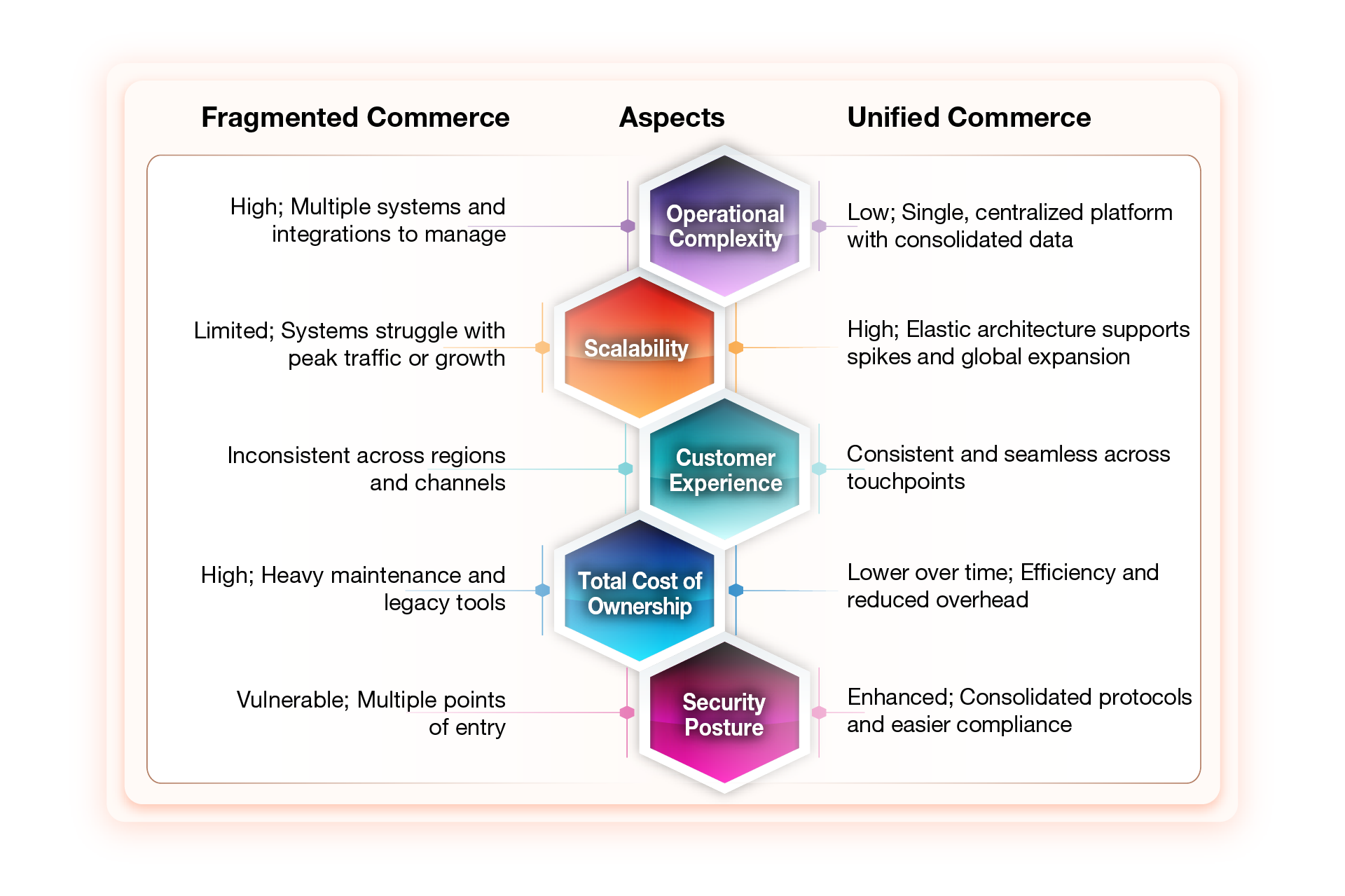
EY research underscores the point: retailers that unify commerce operations reduce time-to-market for digital initiatives by up to 30% and cut technology run costs by double digits. In today’s hyper-competitive landscape, those savings can be reinvested into customer-facing innovation.
A Pragmatic Path to Unification
At HTC Global Services, we believe that digital modernization is not about tearing everything down and starting from zero. It is about architecting strategically but elevating proven platforms, phasing change intelligently, and embedding resilience at every layer.
In the case of the global retailer, the strategic choice was not to chase a shiny new platform. Instead, the decision was to elevate the existing ASP.NET Core platform into an enterprise-grade solution, combining its flexibility with enterprise-class scalability, security, and orchestration.
This transformation followed a phased rollout strategy:
– Phase 1: Soft launch in one region, enabling optimization and issue resolution in a lower-risk environment.
– Phase 2: Full-scale deployment across other regions, incorporating insights and ensuring stability.
The approach balanced speed with stability; what Forbes calls “the discipline of transformation.” In their analysis, enterprises that treat transformation as iterative journeys, rather than big-bang overhauls, are 1.8x more likely to succeed in scaling digital initiatives.
Engineering Seamless Commerce: Beyond the Platform
Unification is not just about consolidating systems but it’s about reimagining the end-to-end commerce experience. In the retailer’s journey, integration became the differentiator:
– Payments Reimagined: A flexible checkout framework capable of handling credit cards, single or multiple gift cards, hybrid payments, and even charitable donations; thus enabling frictionless customer journeys.
– Fulfillment Made Smarter: Integration of shipping calculators, tax engines, and address verifiers ensured precision, speed, and compliance in every order.
– Personalization Embedded: With unified data streams, marketing automation tools could finally deliver context-rich, personalized campaigns at scale.
By harmonizing the technology stack, the retailer achieved consistency across regions, lower operational costs, and a reduction in complexity that freed teams to focus on innovation rather than firefighting.
Looking Ahead: Trends Defining the Future of Commerce
A unified commerce platform is not the end, but it is the beginning of sustained digital leadership. With a modernized foundation, retailers can confidently embrace the next wave of innovation.
1. AI-Driven Personalization: Unified data unlocks true personalization. Gartner reports that 86% of consumers are open to personalization, but they demand relevance and transparency. Beyond product recommendations, the future is dynamic content, predictive service, and hyper-localized promotions.
2. Headless Commerce: Decoupling the customer-facing experience from the back-end unlocks agility. From IoT devices to voice assistants to in-store kiosks, retailers can innovate without disrupting business logic. Forbes describes headless commerce as the “innovation accelerant” enabling brands to compete with digital-first disruptors.
3. Omnichannel Fulfillment: “Buy Online, Pick Up In-Store” (BOPIS), ship-from-store, and same-day delivery are no longer differentiators, but they are table stakes. A unified platform provides the orchestration layer to deliver these seamlessly. According to EY, 70% of consumers expect cross-channel consistency, and unified platforms make this expectation a reality.
4. Sustainable Logistics: Consumers are voting with their wallets. A recent PwC consumer study revealed that 55% of shoppers are willing to pay a premium for eco-friendly products. Unified commerce enables eco-packaging, carbon-neutral delivery, and route optimization to make sustainability operationally viable and commercially rewarding.
5. Mobile-First Design: With mobile commerce projected by Statista to surpass $4.5 trillion globally by 2027, retailers must prioritize mobile-first experiences. Unified platforms ensure consistency, speed, and adaptability across devices.
Executive Imperative: Act Now, Not Later
The commerce landscape is unforgiving to laggards. Fragmentation may feel manageable today, but its hidden costs compound the operational inefficiency, security exposure, and customer attrition. By contrast, unification unlocks scalability, resilience, and the ability to innovate at speed. As Forbes succinctly puts it: “In retail, transformation delayed is leadership denied.”
At HTC Global Services, our philosophy is simple: build today for tomorrow’s growth. With deep expertise in digital modernization, cloud adoption, and AI, we help enterprises reimagine their commerce backbone and not as a cost center, but as a growth engine.
The journey of our retail client illustrates this truth: a unified commerce platform is not just about technology. It is about creating a strategic foundation for resilience, relevance, and reinvention in an era where digital is the default.
Conclusion: From Survival to Leadership
Retail is entering its next decade of disruption with a market size of nearly 40 Trillion Dollars by 2030, according to Mordor Intelligence. Those who cling to fragmented, legacy systems will find themselves outpaced by competitors who have built for agility and scale. Those who unify, however, will stand ready to not only survive but to lead.
The unified commerce platform is more than a system upgrade. It is a strategic imperative, a boardroom priority, and a competitive advantage that will define the leaders of tomorrow’s retail.
At HTC Global Services, we don’t just deliver platforms, but we deliver foundations for growth, trust, and transformation. Because in today’s digital economy, unification isn’t optional. It’s the difference between playing catch-up and setting the pace.
References
1. https://www.pwc.com/gx/en/services/forensics/economic-crime-survey.html
2. https://www.pwc.com/gx/en/industries/consumer-markets/consumer-insights-survey.html
3. https://www.statista.com/statistics/1224510/mobile-commerce-sales-worldwide/
4. https://www.mordorintelligence.com/industry-reports/retail-industry