

Artificial Intelligence is no longer optional; it’s rapidly becoming fundamental to how software is conceived, built, tested, and maintained. According to Gartner¹, by 2028, 75% of enterprise software engineers will use AI code assistants, up sharply from less than 10% in 2023, underscoring a dramatic shift in how engineering team’s work.
At the same time, PwC’s 2025 Global AI Jobs Barometer² highlights that AI has the potential to make people more valuable, not replace them, fundamentally reshaping jobs, productivity, and skills demand across industries.
These signals are not hype. They point to a structural change in the Software Development Life Cycle (SDLC). As organizations move from experimentation to intent-driven adoption, the real opportunity lies not in whether AI should be used, but in how it is integrated to deliver sustained, measurable impact.
The New Anatomy of Modern SDLC
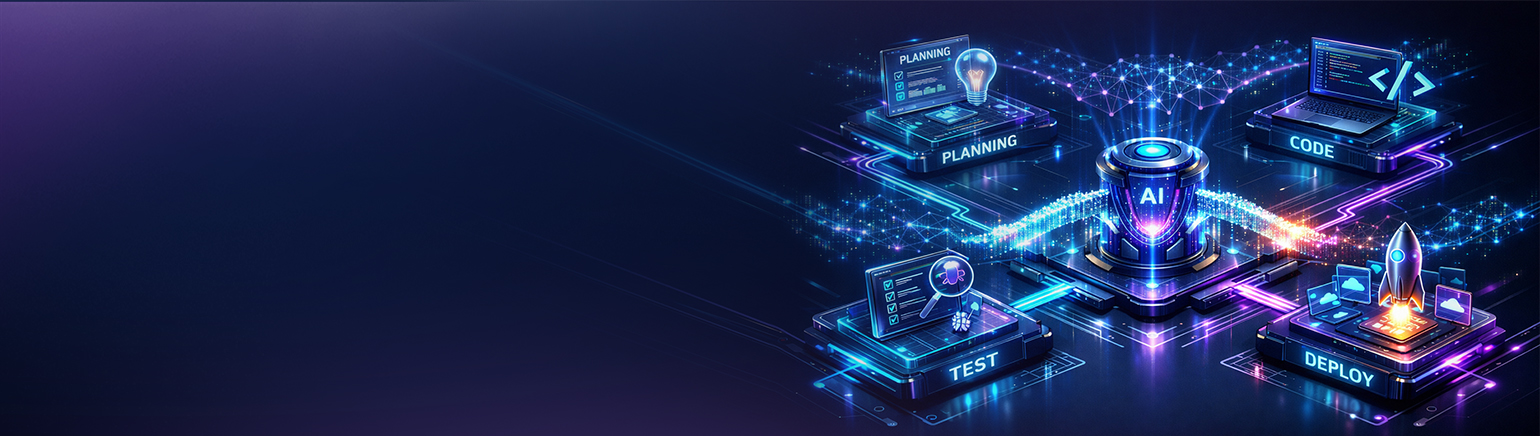
AI isn’t rewriting the SDLC; it’s reshaping its rhythm. What used to be a linear path of plan, build, test, and deploy has evolved into a continuous cycle of learn, predict, and improve.
- Plan smarter: AI-driven analytics help teams predict bottlenecks, optimize sprint planning, and align development priorities with business outcomes.
- Build faster, better: Copilots accelerate secure, reusable code creation while learning from patterns unique to each team.
- Test intelligently: AI detects defect clusters, automates unit and functional testing, and reduces rework cycles.
The result isn’t just faster delivery; it’s smarter delivery, where human creativity is enhanced by machine precision.
The Co-Pilot Reality: Why Expectations Matter
One of the most important lessons in AI-augmented development is understanding what AI truly represents. It is a co-pilot, not an autopilot.
Teams that expect AI to replace human judgment quickly encounter limitations. Outputs may lack business context, overlook edge cases, or compile cleanly while missing strategic intent. In contrast, teams that treat AI as a collaborative partner unlock real value.
Like an experienced pair programmer, AI accelerates routine tasks, suggests alternative approaches, and frees developers to focus on complex problem-solving. However, this requires skill. Prompt quality directly influences output quality, making prompt engineering a core competency rather than an optional skill.
This shift introduces a new form of engineering literacy, one where developers learn to articulate intent clearly, validate outputs critically, and integrate AI suggestions within established quality frameworks.
The Real Challenges Behind AI Productivity
Despite rising adoption, many organizations struggle to translate AI usage into measurable outcomes. Productivity gains are rarely automatic. They emerge only when AI is applied strategically across development stages.
Common barriers include:
- Undefined metrics for measuring AI impact
- Weak governance and security guardrails
- Cultural resistance driven by mistrust or unclear expectations
AI does not accelerate delivery by default. Clear success criteria, disciplined measurement, and developer trust are essential to realizing its potential.
Shifting the Needle: What Works in Practice
Many teams look for a “silver bullet” that instantly improves delivery. The reality is that structured adoption, measured, governed, and aligned with existing workflows, is what drives sustainable change.
At HTC Global Services, we applied this principle across a pilot and scaled rollout within our delivery teams. Instead of treating AI as a feature, we treated it as a capability woven into established development processes, with clear success metrics and training in prompt engineering and secure usage.
Here’s what we observed as adoption matured:
- ~40% productivity increase in developer output
- 90% task success rates with AI-assisted work
- Fewer human errors and better code Readability and Maintainability
- Rapid Research and Summarization that sped up decisions
- Over 15% gain in sprint productivity across teams
- Defect density of <0.25 per story point as compared to “pre-ai” metric of .5 defect per story point
These results underscore a common truth: AI’s impact is magnified when it augments developer intent rather than replacing it.
From Insight to Enablement:
Realizing this kind of structured impact at scale is hard without the right AI Tool or an embedded Framework. That’s where AI (Co-Pilot or other tools) enters, not as another buzzword, but as a structured framework that embeds intelligence into the SDLC with governance, traceability, and contextual awareness.
Well-designed AI adoption approach helps teams:
- Generate high-quality, secure code with context
- Integrate automated test generation and defect prediction
- Standardize governance and compliance checks
- Track productivity and quality outcomes quantitatively
- Support learning and reuse across teams
It’s not just an AI tool; it’s a delivery enabler designed to help organizations operationalize what leading teams have learned about productive AI adoption.
AI as a Cultural Advantage
The future of software delivery is not defined by whether AI is present, but by how deeply it is embedded into the way teams think and work.
Successful organizations will treat AI adoption as a cultural shift rather than a tooling exercise. Knowledge sharing replaces mandates. Review processes evolve. Training becomes continuous. Over time, AI-augmented development becomes the path of least resistance rather than an imposed change.
When that happens, intelligence becomes part of the organization’s fabric, not an external dependency.
Final Thought
The SDLC of tomorrow will not be defined by faster coding alone. It will be defined by smarter delivery, stronger quality, and cultures that treat AI as a long-term capability rather than a short-term experiment.
Approached with discipline, measurement, and respect for human judgment, AI delivers more than productivity gains. It delivers a durable competitive advantage in how software is built.
References:
¹ Gartner Says 75% of Enterprise Software Engineers Will Use AI Code Assistants by 2028
² https://www.pwc.com/gx/en/services/ai/ai-jobs-barometer.html