

In today’s hyper-competitive retail landscape, the ability to bring products to market swiftly and accurately can make the difference between thriving and merely surviving. Yet, for most retailers, distributors, and manufacturers managing hundreds of thousands—sometimes millions—of products, the journey from product conception to market availability remains fraught with inefficiencies, errors, and missed opportunities.
Having witnessed the evolution of retail operations over two decades, I’ve observed a persistent challenge that continues to plague organizations of all sizes: the complex web of product information management that spans multiple departments, applications, and stakeholder groups. The solution isn’t just about better technology—it’s about fundamentally reimagining how we approach product lifecycle management.
The Hidden Costs of Fragmented Product Management
Consider the typical scenario facing today’s category managers. They’re continuously expanding their product portfolios to meet growing customer demands and capitalize on seasonal opportunities. However, each new product introduction triggers a cascade of data entry requirements across multiple systems—merchandising applications, warehouse management systems, financial platforms, e-commerce sites, and more.
To understand the complexity involved, consider the vast array of data elements required for a single product:
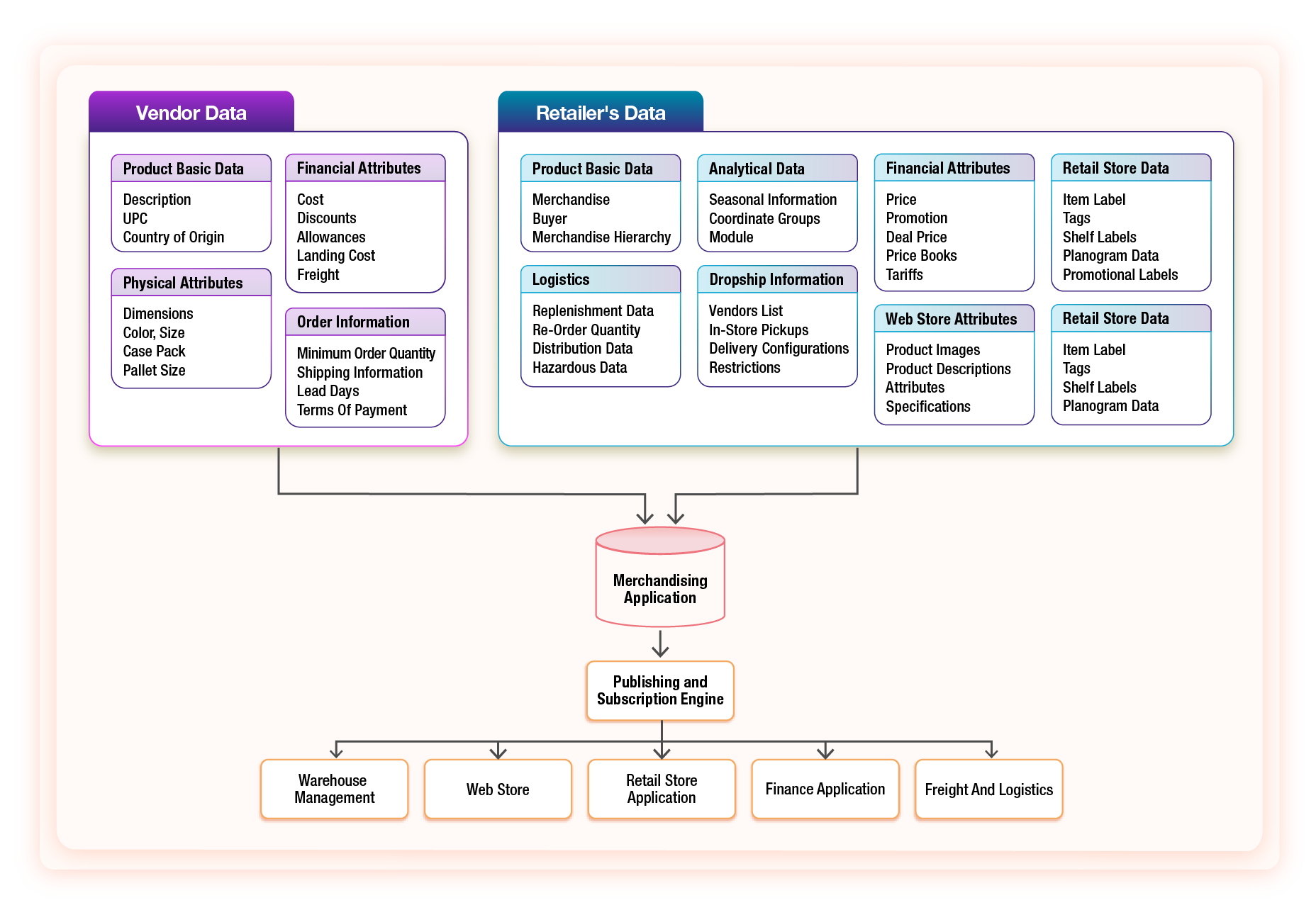
This data complexity across vendor and retailer domains creates several critical pain points:
The Error Multiplication Effect: When product information is manually entered into multiple systems, errors don’t just occur, they proliferate. A single mistake in a product description or pricing can cascade across the entire supply chain, impacting inventory management, customer experience, and financial reporting.
The Configuration Bottleneck: Merchandisers often find themselves blocked by system configurations they cannot modify, forcing them to halt their workflow and seek technical assistance. This dependency creates unnecessary delays and reduces overall productivity.
The Network Vulnerability: In our interconnected world, network communication issues can bring product creation processes to a standstill, with no built-in resilience to handle temporary disruptions gracefully.
The Resource Drain: Perhaps most significantly, valuable human resources—merchandisers who should be focused on strategic market analysis and vendor relationships—instead spend countless hours on repetitive data entry tasks.
The Centralized Solution: A Strategic Framework
The answer lies not in incremental improvements to existing processes, but in a fundamental shift toward centralized product lifecycle management. This approach transforms product creation from a reactive, fragmented process into a proactive, orchestrated workflow that leverages automation, intelligence, and stakeholder collaboration.
Building an Intelligent Workflow Ecosystem
The most effective centralized systems begin with the stakeholders closest to the product source: vendors and suppliers. By establishing a portal that accommodates both manual and automated data submission, organizations can capture product information at its origin while maintaining quality control through structured workflows.
This initial capture triggers an intelligent progression through the organization. Each department receives automated notifications to contribute their specialized information—pricing from finance, logistics details from distribution, marketing copy from merchandising—without the traditional delays and communication gaps.
The intelligence built into this workflow becomes a force multiplier. When the system recognizes that items within a specific department category share similar attributes, it can pre-populate data entry forms, dramatically reducing manual input while improving consistency. This learned intelligence evolves with the business, becoming more accurate and efficient over time.
Configuration-Driven Decision Making
One of the most powerful aspects of centralized product lifecycle management is shifting from manual decision-making to configuration-driven processes. Rather than requiring human intervention for routine decisions about pricing tiers, distribution channels, or compliance requirements, the system applies business rules automatically.
This approach provides remarkable agility when market conditions change. Whether responding to new tariffs, competitive pricing pressures, or vendor cost fluctuations, modifications can be implemented through configuration changes that immediately affect all relevant products across all systems.
The Competitive Advantages of Centralization
Organizations that successfully implement centralized product lifecycle management realize benefits that extend far beyond operational efficiency:
Future-Proofing Technology Investments: When product creation processes exist independently of core merchandising applications, organizations gain flexibility in their technology evolution. System replacements or upgrades require minimal disruption to established workflows.
Accelerated Distribution: Product information flows to dependent applications—warehousing, finance, retail systems, e-commerce platforms—with unprecedented speed and accuracy. This velocity translates directly into faster time-to-market and improves customer satisfaction.
Unified Business Rules: Perhaps most importantly, centralized management ensures that business logic remains consistent across all applications. This uniformity eliminates the discrepancies that often arise when similar rules are implemented differently across various systems.
Proof of Concept: Real-World Transformation
To illustrate the transformative potential of these principles, let me share a compelling example from a recent implementation that perfectly demonstrates the power of centralized product lifecycle management.
A major retailer faced an increasingly complex challenge through their Dropship Program. Vendors were introducing new items daily, creating an overwhelming demand for SKU creation that consumed thousands of hours of merchandiser time monthly. Their IBM iSeries-based merchandising system, while robust, required manual data entry for each new product across multiple database files and dependent applications.
The Implementation Framework
We designed a three-tiered automation framework that embodied the centralized approach:
Vendor Engagement Layer: A lightweight portal enabled vendors to submit product data directly, eliminating the first step of manual data collection. This simple interface captured essential information—product names, categories, dimensions, part numbers—while maintaining data quality through validation rules.
Intelligent Enrichment Layer: Internal teams used a specialized application to validate vendor data and add business-specific attributes such as pricing strategies, tax codes, and shipping parameters. The system applied learned business rules to pre-populate common attributes, reducing manual effort while ensuring compliance with organizational standards.
Automated Integration Layer: The crown jewel was a robust interface that automatically updated all relevant database files in the IBM iSeries system and propagated changes to dependent applications in real-time. This layer included sophisticated self-healing logic to handle missing cross-references, network interruptions, and data validation errors without human intervention.
Revolutionary Results
Over five years of operation, this system has created hundreds of thousands of SKUs while reducing manual effort by over 90%. Data entry errors have been virtually eliminated, and merchandisers have been freed to focus on strategic activities like market trend analysis and vendor relationship management.
The business impact extends beyond operational metrics. New products now reach market within hours rather than days, vendor collaboration has improved dramatically, and customers experience a constantly refreshed product selection that responds quickly to market trends.
Perhaps most significantly, the system includes intelligent assortment creation. When a vendor uploads multiple related products—say, 20 different yoga mats—the system automatically creates logical groupings like “Fitness Essentials” assortments, enabling more sophisticated merchandising strategies without additional manual effort.
Strategic Recommendations for Implementation
Based on extensive experience implementing these systems, several critical success factors emerge:
Start with Stakeholder Alignment: Successful centralization requires buy-in from all departments involved in the product lifecycle. Begin with workshops that map current processes and identify pain points that centralization can address.
Design for Intelligence: Build systems that learn from data patterns and user behavior. The most successful implementations continuously evolve their automation rules based on observed patterns.
Plan for Resilience: Network issues, system outages, and data anomalies are inevitable. Design self-healing capabilities and graceful degradation strategies from the beginning.
Measure Beyond Efficiency: Track not just time savings and error reduction, but also strategic metrics like time-to-market improvement, vendor satisfaction, and merchandiser satisfaction with their role evolution.
The Strategic Imperative
As retail continues its digital transformation, organizations that recognize product lifecycle management as a strategic differentiator rather than an operational necessity will thrive. Centralized approaches transform traditional cost centers into competitive advantage engines.
The evidence is clear: retailers implementing sophisticated, centralized product lifecycle management systems don’t just improve operations—they fundamentally enhance their ability to respond to market opportunities, collaborate with vendors, and serve customers with relevant product selections.
In an era of escalating customer expectations and intensifying competitive pressures, maintaining fragmented, inefficient product management processes is no longer viable. The tools and methodologies exist today to transform these critical operations. The question isn’t whether to pursue centralized product lifecycle management, but how quickly you can implement it to maintain a competitive edge.
The retail landscape rewards agility, accuracy, and efficiency. Centralized product lifecycle management delivers all three while positioning organizations for sustainable competitive advantage in an increasingly dynamic marketplace.