



Documentation barely receives attention in an organization. It feels ordinary, easy to postpone, and easy to ignore. Yet it remains the quiet force that supports every successful business. It protects clarity, preserves knowledge, and keeps work from drifting into confusion. This instinct to capture and pass on knowledge is not new. Long before businesses existed, humans understood that progress depends on memory, not repetition.
When Documentation First Took Shape
Humanity has always searched for ways to record what it discovers.
From the stone carvings of early civilizations to the paintings in Lascaux, from the clay tablets of Mesopotamia to the papyrus scrolls of ancient Egypt, and later to Gutenberg’s printing press, each era built its own system for preserving learning.
These were not just artistic or administrative acts. They were deliberate attempts to build continuity. Civilizations recognized that their survival depended on shared memory, agricultural techniques, astronomical observations, laws, trade records, and stories. Each written mark was a bridge from one generation to the next. Without these efforts, collective wisdom would have splintered, and every era would have been forced to relearn the basics of living and governing.
Even the discovery of fire would have required constant reinvention. Documentation has always been the structure that carries knowledge forward.
The Blind Spot of the Digital Age
Despite this deep history, documentation in today’s digital workplaces often receives little attention. It is pushed aside as teams move quickly across tools, chats, shared drives, and applications. Information spreads, but understanding does not.
Organizations today generate more information in a week than entire civilizations once created in decades. Yet the ability to retrieve, interpret, and apply that information has not kept pace. Files multiply. Versions get lost. Decisions sit in private threads. Knowledge becomes siloed, and the people who hold critical information become accidental gatekeepers. Even high-performing teams struggle when documentation falls behind.
Studies show that knowledge workers lose a significant amount of time searching for information. Many spend hours each week trying to locate the right version of a file or the latest instruction. For large organizations, this scattered knowledge translates into substantial financial loss. When documentation is accessible, accurate, and easy to navigate, that lost time becomes regained capacity. In many enterprises, fragmented systems can cost millions each year. This makes documentation not a support function, but a strategic asset.
The Cost of Lost Knowledge
The fact is, the cost of missing documentation is not theoretical. It shows up in time, money, and momentum.
- According to Forrester¹, knowledge workers lose 30 % of their time looking for data.
- Another report² says that 10% of workers spend four hours a week searching for information.
If documentation is easy to access, up-to-date, and structured, this lost time gets reclaimed.
- A study by Quickbase cites that for a 1,000-person organization, time spent searching across fragmented systems costs about US $2.5 million per year.
So, documentation is not just “nice to have”, it’s a business lever.
Why leaders will feel this
Up to that point, they are nodding. At this point, they start calculating.
This is the moment the article quietly shifts from reflection to decision logic. The rest of your piece then builds naturally toward strategy, leadership perspective, and outcomes.
When Information Gaps Turn Into Guesswork
The cost of poor documentation shows up across the product lifecycle.
- App launches slow down when downstream teams do not have updated specifications.
- Support teams face more tickets because users cannot move forward without guidance.
- Product adoption drops even when features are strong, simply because people do not understand how to use them.
- Developers and production teams rely on outdated notes, creating confusion and unnecessary rework.
These gaps create invisible friction that impacts more than timelines. Teams lose confidence in the information they receive. Leaders struggle to get a reliable picture of progress. Knowledge becomes unevenly distributed, making onboarding slower and cross-team collaboration harder. A single missing document can change the trajectory of a sprint, a release, or an entire project.
In these moments, time is lost not only in completing the work but also in trying to figure out what needs to be done in the first place.
Turning Documentation Into Strategy
Organizations that treat documentation as a strategic function gain stronger, faster, and more predictable outcomes. The shift begins when documentation becomes a continuous part of the product lifecycle, not a final step.
A Visible Asset
Documentation works best when it grows alongside the product. It should capture the evolution of features and decisions instead of being reserved for the end of a release cycle. Treating documentation as a living asset reduces the risk of knowledge gaps and helps teams maintain continuity even as people shift roles or projects.
Structured for Reuse
Strong documentation is not a static collection of pages and screenshots. It is a deliberate structure that connects roles, tasks, problems, and solutions, making it possible to reuse knowledge instead of recreating it. Reusable documentation accelerates development, improves customer-facing content, and reduces dependency on individual memory.
Supporting Governance and Compliance
Documentation strengthens audits, learning programs, onboarding, and governance. Clear information builds trust across teams and with customers. In regulated industries, it becomes the backbone of compliance and reduces the cost of proving process consistency.
Time Saved Equals Capacity Gained
When teams no longer spend hours searching or debating assumptions, they gain time for high-value work. Companies with strong documentation practices report faster decisions, better collaboration, and improved customer satisfaction. Over time, this clarity compounds into competitive advantage.
Fun Fact: When Meaning Gets Lost in Day, Night, and Race Mode
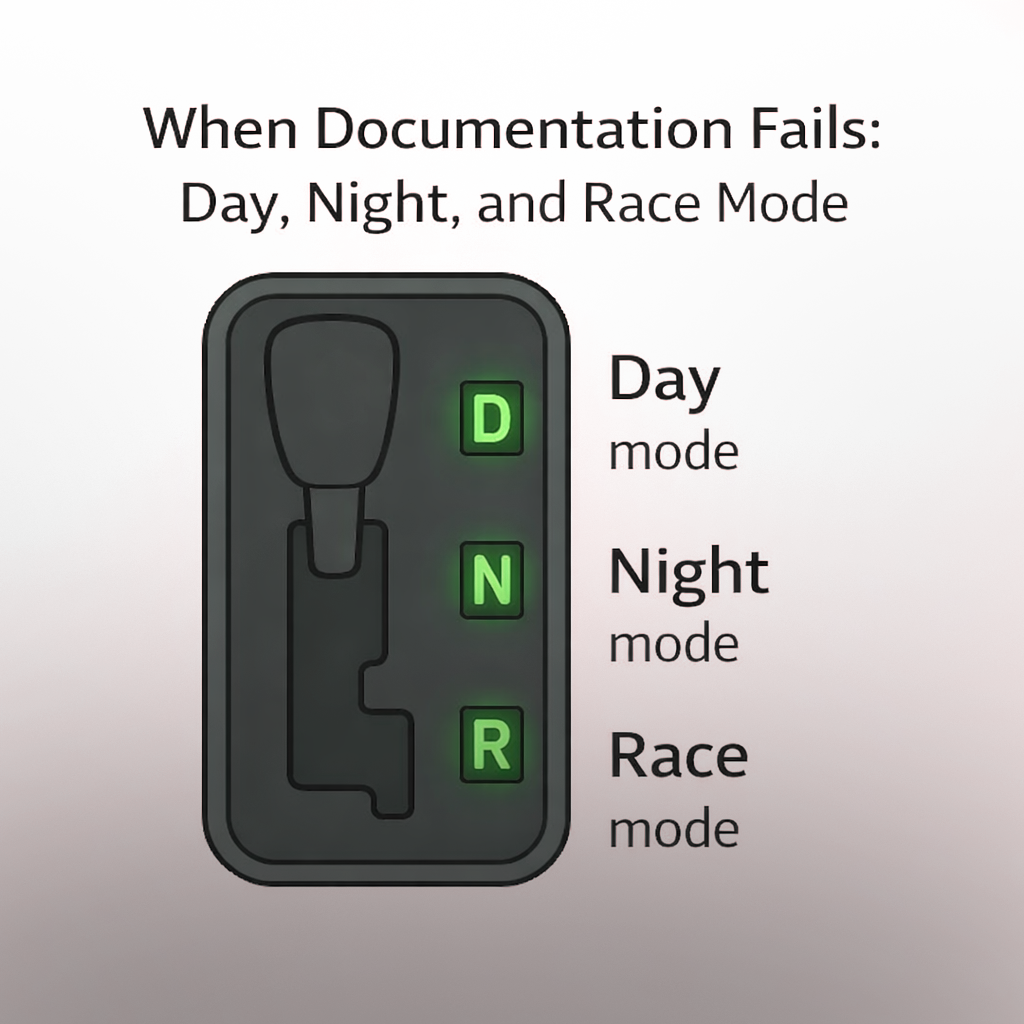
A widely shared prank video shows a first-time automatic car owner confidently explaining the meaning of the gearbox letters.
D, he says, stands for Day.
N clearly means Night.
And R, of course, is Race.
It is funny because it sounds logical.
It is relatable because the confidence feels real.
No one had explained what those letters actually meant. There was no quick guide, no simple reference, no clear documentation. Faced with that gap, the driver filled in the meaning himself. The assumptions felt right until the car behaved very differently from what he expected.
That moment mirrors a familiar pattern inside organizations.
When documentation is missing or unclear, people do what humans naturally do. They invent meaning. Teams interpret processes based on partial context. Work moves forward on belief instead of shared understanding. Everything appears fine until an error exposes the misunderstanding.
It often looks something like this:
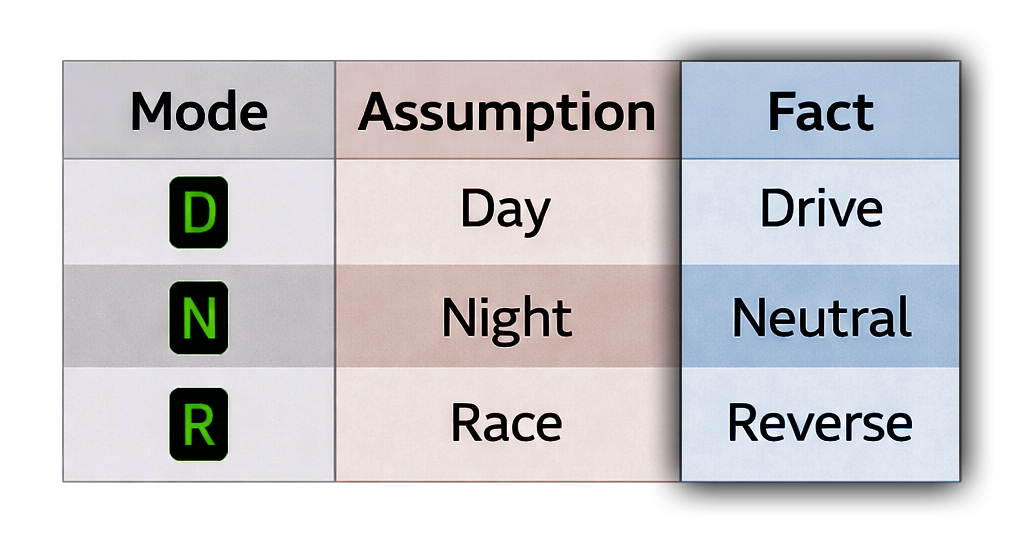
This is how breakdowns form in enterprise environments. The system works exactly as designed. The interpretation does not.
Clear documentation is what prevents Drive from quietly turning into a race in reverse. It replaces confidence built on guesswork with clarity grounded in shared truth.
What Our Leaders Say About the Importance of Documentation
“Modernizing undocumented mainframe systems has taught us a crucial lesson: documentation is not optional.” – Adnan Saulat, SVP, Practice Sales
“Documentation is not a one-time effort but a living asset that evolves with the product. Striking the right balance ensures it remains relevant, accessible, and ready for daily consumption across teams.” – Srinivasa Peddireddy, Director, ADM
“Documentation plays a vital role in enabling business communication, seamless onboarding, and consistent project development. It guarantees continuous learning, team collaboration and efficiency. It also minimizes errors and simplifies future readiness.” – Chandrasekhar Maddilla, Senior Director, Training
“I believe that documenting processes brings us closer to predictable success. Great teams write things down because clarity today leads to growth tomorrow. Documentation is not just a chore. It is the foundation for scaling and winning.” – Vish Rao D., AVP, ADM
“Documentation is the cornerstone of a successful engagement. It is the combined intelligence of the team. With clear and consistent documentation, every team member can operate at the same level of expertise. This reduces dependency, increases efficiency and drives higher throughput.” – Cecil Peter Sesuraj, Senior Director, ADM
What Clarity Gives Back to the Business
Organizations that invest in clear, structured documentation gain measurable advantages:
- Reduced operational cost
- No duplication of effort
- Less time spent searching for information
- Stronger product adoption
- Higher customer trust
- A continuous learning culture
- Better compliance preparedness
Documentation provides the clarity that supports long-term operational excellence. It also creates resilience. When teams scale, onboard new members, or adopt new tools, a well-documented knowledge system becomes the anchor that keeps progress steady.
Documentation is the knowledge backbone every enterprise runs on. It protects continuity, strengthens decision-making, and turns information into shared intelligence. When organizations invest in documentation, they build a foundation of clarity that outlives projects, transitions, and change. It is the quiet partner that keeps an enterprise aligned today and ready for tomorrow. Let us build that clarity together, one page at a time.
At HTC, documentation is more than a process; it’s our promise of precision. We align people, process, and technology to drive consistency, transparency, and quality and shape Clarity in documentation to deliver excellence.
Let’s connect and build clarity together, one page at a time!
References:
¹https://www.cdpinstitute.org/news/knowledge-workers-lose-30-of-time-looking-for-data-forrester-study/
² https://www.business.com/articles/7-statistics-that-will-make-you-rethink-your-document-management-strategy/