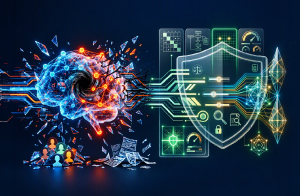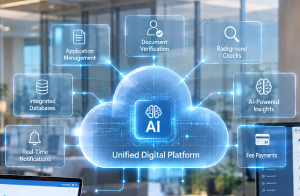



The application stack is not getting an AI feature. It is being inverted. Five quiet inversions are happening at the same time, in different parts of the stack, in different industries, under different vendor names. Once you see them together, the rest of the change makes sense. This essay names the five, and traces what each one demands of the people who build, run, and live inside software.
1. The Inversion of Initiative
Software used to wait. Now it acts.
For thirty years, the unit of value in software was a transaction triggered by a human. In the agent era, the unit of value is an outcome produced by a system. The contact center stops waiting for a ticket and intervenes mid-call. The customer data platform stops waiting for a campaign and triggers the next best action in seconds. The IDE stops waiting for a keystroke and proposes the next pull request. The thread that connects these is not “more automation.” It is initiative migrating from the human to the system.
The practical test for any team. When did your software last initiate something useful on its own? If the answer is never, the team is still building for the pre-agent era, even if it has shipped a chatbot.
2. The Inversion of Audience
UIs used to have one audience. They now have two.
Every interface used to serve a human. The new interface serves a human in front of the screen and an agent that can act on the human’s behalf. That double audience changes everything downstream. Generative UI emerges because the agent needs the front-end to be assembled at runtime instead of designed once and shipped. Voice rises because the agent often does not need a screen at all. Storefront APIs are redesigned for agent callability because the buyer might never visit a product page.
Every component is now a dual-readable artifact. It has an experiential surface, what a human perceives, and a semantic surface, what an agent can act on. The companies that learn to design both layers together will produce software that feels, paradoxically, more human than the human-only era ever did.
3. The Inversion of Data
Data was something you stored. Memory is something you reason from.
The old customer data platform was a lake. You filled it, queried it, exported the result to a campaign tool, and waited a week. The new one is a memory. In the agent era, every interaction reads from and writes to the same persistent context. The storefront assistant updates it. The support agent reads it. The marketing brain learns from it. The unit of work is no longer a segment built on Monday. It is a loop that runs in seconds. Read profile, decide, act, observe, learn.
Configurators get sharper. Voice agents become coherent across sessions. Contact centers stop starting from zero. The deepest architectural decision a company will make in the next five years is whether its customer record is built for storage or built for memory. There is no middle ground that scales.
4. The Inversion of the Destination
Customers used to come to your software. Now their agents do.
The website was the destination. The app was the destination. Twenty years of digital design assumed the customer would come to us. That assumption is breaking. In the agent era, the customer’s own agent visits many companies, often invisibly, on the customer’s behalf. It cancels a subscription, negotiates a refund, compares three quotes, places an order. The brand’s site is no longer a place a person browses. It is an API surface that another agent calls.
That is a profound inversion of competitive logic. The bar for a good customer experience used to be a slick homepage. The new bar is whether the brand behaves correctly when a customer’s agent arrives to do business on their behalf. Clean APIs, machine-legible policies, agent-friendly checkout, identity that survives the handoff. The brands that prepare for this will feel invisible and elegant. The ones that do not will feel slow, even if they thought they were modern.
5. The Inversion of Modernization
Legacy used to be rewritten from the inside out. It will now be modernized from the outside in.
For forty years, modernization meant rewriting the database, then the services, then eventually the UI. Most companies never reached the last step. The agent era flips this. The new modernization begins with the verbs. Identify the three or four things a legacy application actually enables. Create order. Schedule appointment. Approve claim. Issue refund. Wrap each verb in a clean, well-authenticated API. Add a memory layer that records who did what, when, and why. An agent can now use the system.
From there, the UI quietly becomes optional. Some users still see screens. Most are served by agents that talk to the verbs directly. Old screens disappear as flows are subsumed. Old business logic gets clarified as it is wrapped. The transformation that companies have promised themselves for fifteen years finally has a forcing function. Stapling a chatbot to an old UI will not work. Treating the agent as the new primary user, and the legacy system as a set of verbs to expose to it, will.
Why the five reinforce each other
The five inversions are not independent. They reinforce each other. Software that initiates is only coherent when it has memory. Memory is only useful when an agent can act on it. An agent only acts because the destination has inverted. The destination only inverted because the audience did. The audience only doubled because initiative moved. Pull on any of the five and the others move with it.
That is why bolting AI onto an existing application produces such modest results. The application was designed for the previous five assumptions. The new value lives in the new five. For organizations rethinking their customer stack, the challenge is no longer adding AI to existing workflows. The challenge is redesigning systems around memory, agency, and machine-to-machine interaction from the start.
The companies that pull ahead in the next decade will not be the ones with the best model access. They will be the ones who saw the inversions early, named them inside their own organizations, and rebuilt the smallest things first. The next ticket. The next design. The next API. The bigger transformation is just the accumulation of those choices, made well, by people who saw the new shape before everyone else.