Introduction: Beyond Fast Orders—The Real Challenge
A good order system isn’t just about processing orders quickly; it’s about knowing what to order, when to order, and how much to stock. The real art lies in predicting demand accurately and avoiding stockouts without overloading inventory. When retailers master this balance, they unlock operational efficiency, better customer satisfaction, and stronger profitability. The secret? A smart blend of predictive technology and human expertise.
Predicting Demand with Data: How a Predictive Inventory System Works
Predicting order quantities begins with understanding demand patterns. Historical sales data remains the most reliable indicator of future demand. By analyzing trends from previous months, seasons, or years, a predictive inventory system adjusts stock levels based on forecasted needs. It uses advanced algorithms that factor in historical sales data, market trends, and seasonality to determine the optimal inventory levels.
Key Elements for Accurate Demand Prediction
Market Trends: It is essential to stay up to date with industry news and developments that impact the demand for products and services. This includes tracking seasonal shifts, new trends emerging within the market, and significant events or promotions that could influence consumer behavior.
Consumer Behavior: Understanding how consumer preferences evolve is crucial to maintaining a competitive edge. Shifts in customer interests or buying habits can be tracked through direct feedback, social media interactions, and surveys. Monitoring online platforms, customer reviews, and industry reports helps identify emerging trends, enabling businesses to adapt their product offerings, marketing strategies, and inventory management to better meet consumer expectations. Such ongoing analysis ensures that businesses remain relevant and responsive.
Local Factors: Regional influences play a key role in shaping demand for products and services. Businesses should consider factors such as local holidays, regional cultural events, economic conditions, and geographic preferences when forecasting demand and planning inventory. These localized elements can significantly affect purchasing behavior and may require adjustments in marketing strategies or stock levels. By being attuned to the unique characteristics of different markets, businesses can enhance their relevance and customer satisfaction within specific regions.
Dynamic Adjustments: Flexibility is a key to effective inventory management. A sophisticated system allows businesses to automatically adjust order quantities based on real-time changes in market conditions.
Seasonal Forecasting: Anticipating seasonal demand fluctuations helps businesses prepare for peak periods and avoid stockouts.
Automated Replenishment: The process of automated replenishment is designed to streamline inventory management by triggering restocking orders based on anticipated demand. Leveraging predictive analytics and real-time data, the system forecasts which products need replenishment and initiates the reorder process automatically. This ensures that inventory levels remain consistent, minimizing the risk of running out of popular items while optimizing stock levels. Automated replenishment helps businesses stay efficient and responsive, reducing manual oversight and preventing stockouts or overstocking issues.
Example Workflow
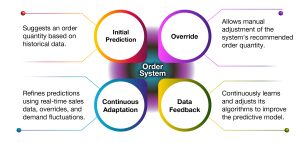
1. Initial Prediction: Based on historical data for a period of 3, 6, or 12 months, the system recommends ordering 300 units of Product A for Store 1 for the upcoming week. If historical data is unavailable, the system references similar retail stores- matched by location type, store size, and target demographics—to generate an informed estimate.
2. Override: The store manager, aware of an upcoming local sporting event likely to boost demand, overrides the system’s recommendations and manually adjusts the order to 350 units.
3. Data Feedback: The system captures the override data in real time, learning from it to refine its algorithms. This enables future demand predictions for Store 1 to better account for the impact of local events.
4. Continuous Adaptation: Over the course of several weeks, the system continually improves, leveraging real-time sales data, manual overrides, and observed demand fluctuations to optimize its predictions and recommendations.
Balance Stockouts and Excess Inventory
The key to success is finding the right balance between stockouts and excess inventory. While stockouts lead to lost sales and dissatisfied customers, overstocking ties up capital and inflates storage costs. Here’s how businesses can manage both effectively:
- Safety Stock Levels: Maintain a small buffer to cover unexpected demand spikes, but keep it lean to avoid unnecessary overstocking.
- Order in Smaller, Frequent Batches: Placing smaller, more frequent orders instead of larger, bulk purchases helps businesses align supply more closely with actual demand. This approach improves inventory turnover and reduces the risk of wasted resources and higher storage costs. Real-Time Data Analysis: Monitor stock levels in real time to quickly respond to changes in demand.
Use Market Trends for Forward Thinking
Market trends are critical for forecasting future demand. Stay informed by closely tracking industry developments, shifting consumer preferences, competitor activities, and broader economic factors. For example, if a competitor runs out of stock or a new product gains sudden popularity, it’s a clear signal to proactively adjust your inventory levels and capture new opportunities.
Conclusion
By blending predictive algorithms with real-time feedback, retailers can respond more accurately and efficiently to demand fluctuations. A predictive inventory system not only improves decision-making but also reduces costs, boosts profitability, and enhances customer satisfaction—helping businesses stay ahead of the competition.
With deep expertise in enterprise solutions and real-time data intelligence, HTC empowers retail businesses to operationalize smarter inventory management, adapt swiftly to market shifts, and drive sustainable growth. Partner with HTC to turn predictive insights into a lasting competitive advantage.