



Ask almost any elected prosecutor what keeps them up at night, and staffing will come up quickly.
The concern is not limited to attorneys. Prosecutor offices are also struggling to recruit and retain paralegals, investigators, victim advocates, case managers, and administrative staff. These are the people who keep evidence moving, communicate with victims, coordinate schedules, prepare documents, track deadlines, and prevent cases from stalling.
Across the country, offices are carrying substantial vacancies while caseloads continue to grow. Indiana prosecutors have estimated that they are operating with roughly 30% fewer attorneys than they need, while some district attorneys’ offices have reported vacancy rates approaching 33%. In several jurisdictions, the shortage extends deep into the support structure of the office, leaving prosecutors to absorb work once handled by victim advocates, paralegals, and administrators.
The instinctive response is understandable:
We need more people.
In many offices, that is true. But it is not the whole answer.
Hiring more people into an operating model built around fragmented systems, manual tracking, duplicate data entry, spreadsheets, email handoffs, and individual memory does not eliminate inefficiency. It simply gives more people the same inefficient environment to navigate.
The staffing crisis is real. But underneath it sits a second crisis that receives far less attention: The loss of operational capacity.
Headcount Is Not the Same as Capacity
Headcount tells an office how many people it employs.
Capacity tells an office how much meaningful work those people can complete.
A prosecutor may carry fewer cases after a new hire joins the team, but if both attorneys still spend hours locating evidence, re-entering information, compiling status reports, and following up manually with other agencies, the office has added staff without fully addressing the friction that consumes their time.
The same is true for support teams.
A paralegal cannot operate at full capacity if critical information is scattered across case systems, shared drives, inboxes, and agency portals. A victim advocate cannot focus on supporting victims if case updates must be pieced together manually. An administrator cannot provide reliable reporting if every division tracks its work differently.
The issue is not effort. Prosecutor offices are already relying on extraordinary effort.
The issue is how much of that effort is being spent on work the operating system should be carrying.
Where Capacity Quietly Disappears
Capacity is rarely lost through one dramatic failure. It disappears through small, repetitive actions performed across every case.
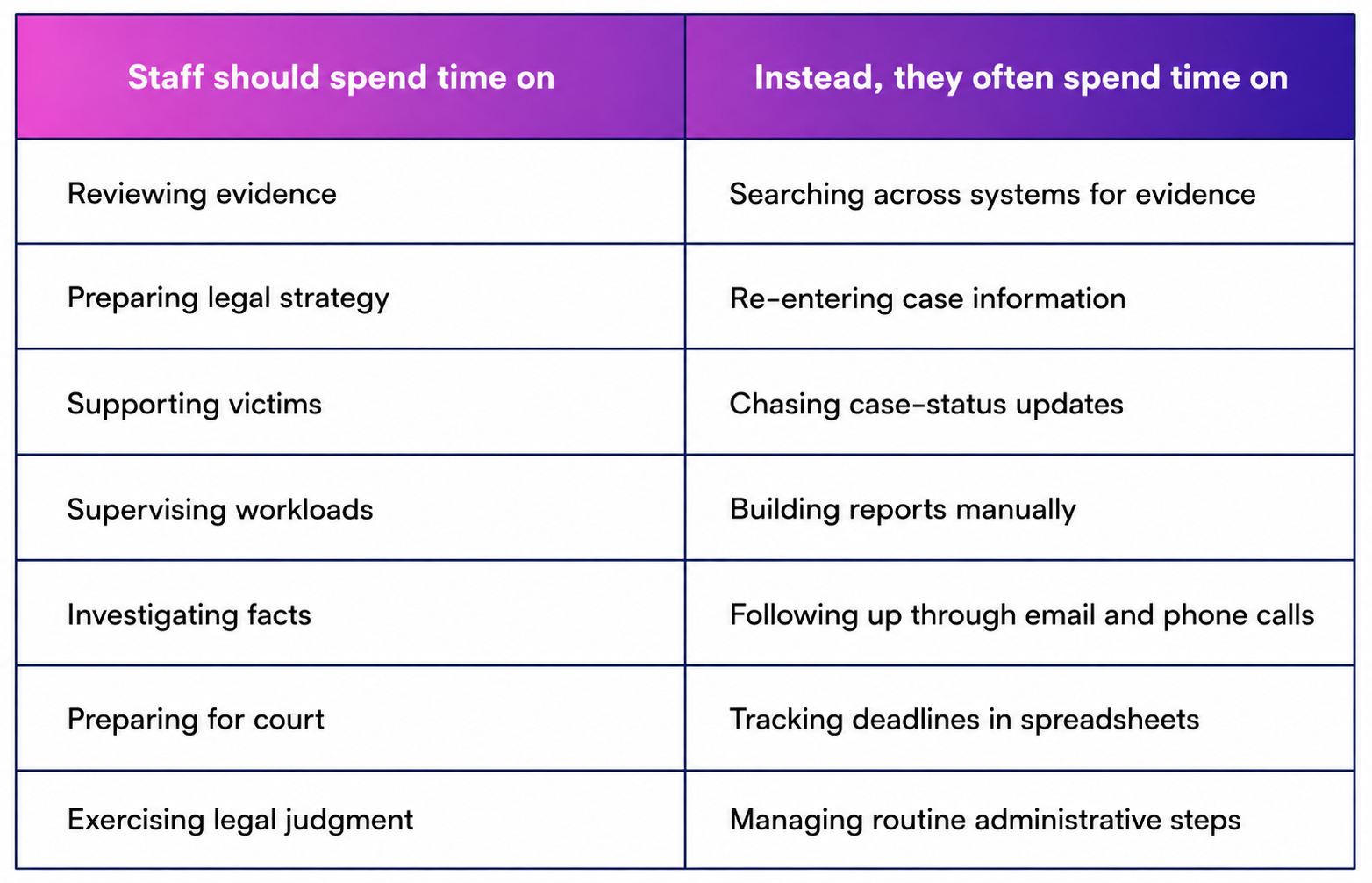
None of these administrative tasks are insignificant. Desirable outcomes on cases depend on them. But not all of them require the sustained attention of an attorney, investigator, advocate, or senior paralegal.
This distinction matters because modern prosecution has become more operationally demanding. Offices must manage criminal history, digital evidence, disclosure obligations, court deadlines, victim communications, diversion programs, public reporting, cross-agency coordination, and increasingly complex case records.
The work has expanded. The systems supporting that work often have not.
The Hiring Pipeline Cannot Be the Only Strategy
Recruitment and retention initiatives remain essential. The HIRRE Prosecutors Act of 2025, for example, proposes federal support for prosecutor recruitment, retention, and professional development. It is an important recognition of the problem.
But hiring pipelines take time to rebuild. Budgets move slowly. Salary competition with private practice remains difficult. In some jurisdictions, even significant salary increases have not produced enough qualified applicants. Caseloads, meanwhile, do not wait.
That is why prosecutor leadership must work on two tracks at once:
Continue advocating for the people the office needs.
And:
Reduce the administrative burden on the people already there.
This is not a choice between staff and technology. It is a question of whether technology is doing enough to support staff.
Treat the System as Part of the Workforce
A modern prosecutor office should not depend on individual employees to remember every deadline, move every task, update every stakeholder, and reconstruct every case status manually.
The system itself should carry more of that weight.
That means automatically routing work to the right role. It means alerting staff when information is missing or a deadline is approaching. It means creating approved documents from existing case data rather than rebuilding them repeatedly. It means connecting with police, court, laboratory, corrections, and evidence systems so information does not have to be manually re-entered each time it moves.
It also means giving leadership a current view of what is happening across the office.
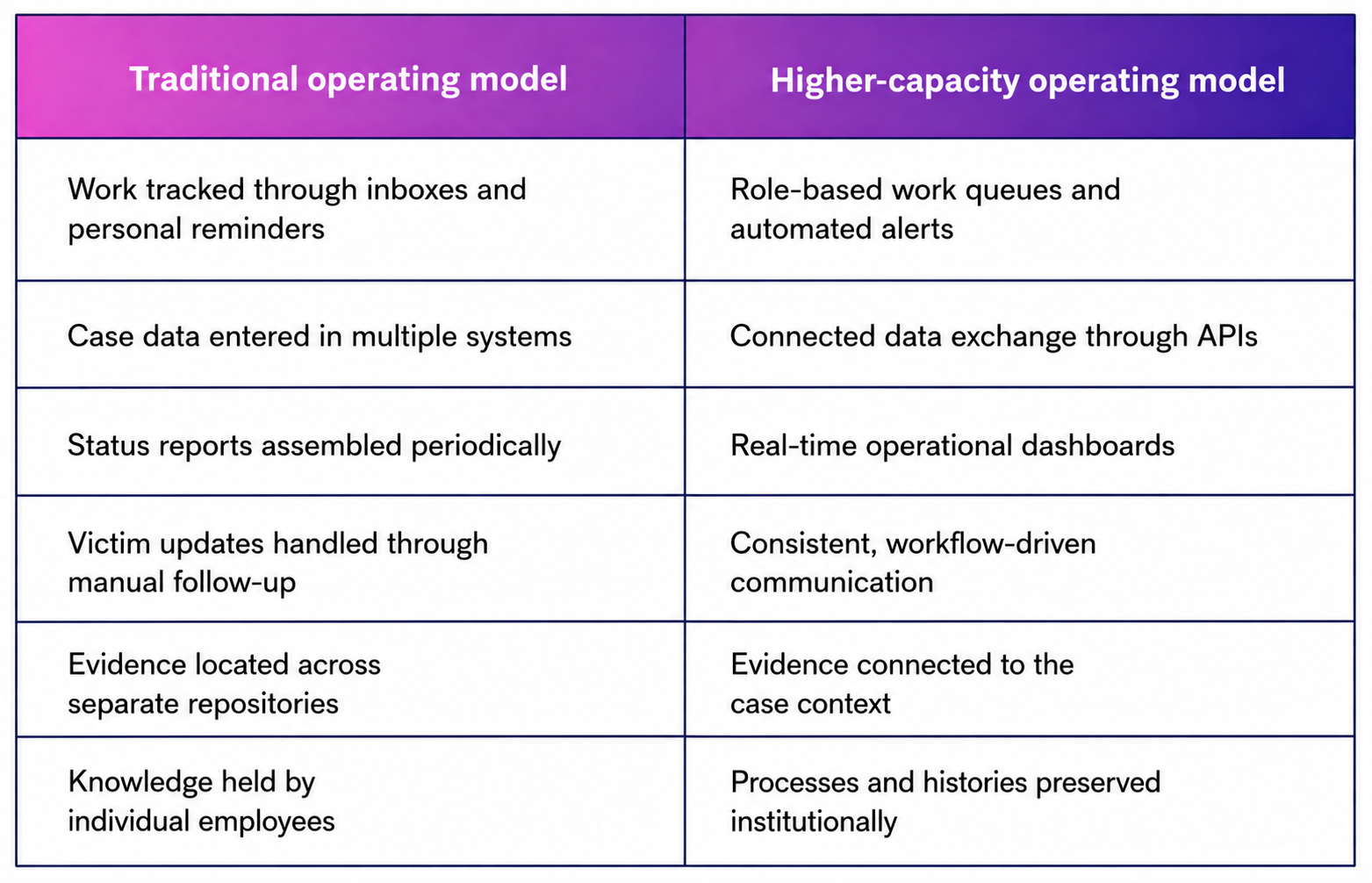
None of this replaces prosecutorial judgment. It protects it.
A prosecutor should decide whether a case should be charged, how it should be resolved, and what justice requires. An investigator should develop facts and pursue leads. A victim advocate should communicate with empathy and support.
The system should handle the repetitive coordination surrounding that work.
Better Operations Are Also a Retention Strategy
Staffing discussions often focus on salary and recruitment. Those issues matter, but the daily working environment matters too. In part, employees experience an office through its systems and processes.
They notice how often information is missing. How many times they must enter the same data. How difficult it is to understand case status. How much work follows them home because routine tasks consumed the day.
A modern operating environment cannot solve every cause of burnout. But a poor one can make every challenge worse.
Reducing unnecessary administrative work helps protect employee time, makes workloads more visible, supports faster onboarding, and allows experienced staff to focus on work that uses their expertise.
That makes modernization not only an IT initiative, but a workforce initiative.
From Case Management to Connected Prosecution
This is the operating philosophy behind HTC CMP NextGen.
HTC CMP NextGen is a cloud-native, modern, prosecutor case management platform designed to bring case information, digital evidence, workflows, documents, work queues, analytics, and cross-agency collaboration into one connected operational environment.
It helps automate routine case activity, improve visibility into workload and case progress, reduce duplicate entry, support disclosure tracking, and connect prosecutor offices with law enforcement, courts, crime labs, and other justice partners.
The objective is not to ask fewer people to do more.
It is to ensure that attorneys and administrative staff are not spending their limited capacity on work a modern system should manage for them.
Prosecutor offices will continue to need more talent, stronger funding, and sustainable staffing models.
In the meantime, explore HTC CMP NextGen.
But the offices best prepared for what comes next will ask one more question:
How much more could our people accomplish if the system carried its share of the work?
That is where the next layer of capacity will be found.
And that is where modern prosecution begins.
References
- American Bar Association, Criminal Justice Section. Prosecutorial Workload: The Hidden Crisis in Criminal Justice. Spring 2025.
- Bureau of Justice Statistics. National Survey of Prosecutors. U.S. Department of Justice.
- The Indiana Lawyer. Indiana Prosecutors Wrestle with Staffing Crunch. April 2026.
- Washington State Bar News. No Rest for the Prosecution. February 2025.
- Office of U.S. Senator Chris Coons. Senators Coons, Murkowski Introduce Bipartisan, Bicameral Bill to Address Prosecutor Hiring Crisis (HIRRE Prosecutors Act of 2025). December 2025.
Frequently Asked Questions
1. Why are prosecutor offices struggling even after hiring more staff?
Hiring more people into an operating model built around fragmented systems, manual tracking, duplicate data entry, spreadsheets, email handoffs, and individual memory does not eliminate inefficiency. It simply gives more people the same inefficient environment to navigate. Offices add headcount without addressing the friction that consumes time, so meaningful capacity does not improve proportionally.
2. What is the difference between headcount and capacity?
Headcount tells an office how many people it employs, while capacity tells it how much meaningful work those people can actually complete. A new hire may reduce an attorney’s caseload, but if both still spend hours locating evidence, re-entering information, compiling reports, and following up manually, the office has added staff without resolving the operational friction that limits output.
3. Where does operational capacity quietly disappear in prosecutor offices?
Capacity is lost through small, repetitive actions across every case: searching across systems for evidence instead of reviewing it, re-entering case information instead of building strategy, chasing status updates instead of supporting victims, compiling reports manually instead of supervising, and tracking deadlines in spreadsheets instead of preparing for court. None of these tasks are insignificant, but many do not require a licensed attorney, investigator, or senior paralegal.
4. Why can’t the hiring pipeline be the only strategy for the staffing crisis?
Recruitment pipelines take time to rebuild, budgets move slowly, and salary competition with private practice remains difficult—in some jurisdictions even large raises have not produced enough qualified applicants. Meanwhile caseloads do not wait. Leadership must run two tracks at once: keep advocating for needed talent and reduce the administrative burden on the people already there.
5. What is the HIRRE Prosecutors Act of 2025?
The bipartisan HIRRE Prosecutors Act of 2025 proposes federal support for prosecutor recruitment, retention, and professional development. Introduced by Senators Coons and Murkowski, it is an important bipartisan recognition of the prosecutor hiring crisis, though it addresses staffing rather than the separate operational-capacity crisis.
6. What does it mean to treat the system as part of the workforce?
It means the operating system itself should carry more of the repetitive coordination weight: automatically routing work to the right role, alerting staff when information is missing or a deadline approaches, generating approved documents from existing case data, connecting with police, court, lab, corrections, and evidence systems to avoid manual re-entry, and giving leadership a current view of office activity.
7. What is “connected prosecution”?
Connected prosecution is the operating philosophy of moving from fragmented case management to a single connected environment where case information, digital evidence, workflows, documents, work queues, analytics, and cross-agency collaboration share context. It replaces personal-reminder tracking, duplicate entry, periodic reports, manual victim follow-up, and scattered evidence with role-based queues, API data exchange, real-time dashboards, and workflow-driven communication.
8. Does CMP NextGen replace prosecutorial judgment?
No. CMP NextGen is designed to protect prosecutorial judgment, not replace it. Prosecutors still decide whether to charge, how to resolve a case, and what justice requires; investigators still develop facts; advocates still communicate with empathy. The platform handles the repetitive coordination and administrative steps surrounding that work so experts can focus on expert-level decisions.
9. How can better operations also serve as a retention strategy?
Employees experience an office through its systems and processes. Reducing unnecessary administrative work protects employee time, makes workloads visible, supports faster onboarding, and lets experienced staff focus on work that uses their expertise. A modern operating environment cannot solve every cause of burnout, but a poor one makes every challenge worse—so modernization is as much a workforce initiative as an IT one.
10. What is CMP NextGen and how does it help prosecutor offices?
CMP NextGen is a cloud-native, API-first prosecutor case management platform that brings case information, digital evidence, workflows, documents, work queues, analytics, and cross-agency collaboration into one connected operating environment. It automates routine case activity, improves visibility into workload and progress, reduces duplicate entry, supports disclosure tracking, and connects offices with law enforcement, courts, laboratories, and other justice partners.