


Cloud governance has become a boardroom priority. As enterprises accelerate digital transformation and adopt AI at scale, unmanaged assets, misaligned configurations, and fragmented controls introduce material risk to security, compliance, reputation, and cost efficiency. Governance can no longer remain a reactive, audit-driven exercise. It must evolve into an automated, operational capability.
This blog introduces Cloud Custodian, an open-source governance framework for automated cloud governance and policy-based automation in cloud computing across modern cloud platforms. Designed for CIOs, CTOs, and technology leaders, Cloud Custodian enables organizations to embed governance directly into cloud operations without slowing innovation.
By adopting a policy-as-code governance framework, enterprises can consistently enforce security, compliance, and financial controls through automated IT security policy enforcement across cloud environments. Governance shifts from periodic reviews to continuous, scalable enforcement that strengthens resilience, trust, and long-term growth.
To extend governance across complex enterprise environments, Cloud Custodian includes c7n-org, a companion orchestration tool. While Cloud Custodian enforces governance within a single subscription or account, c7n-org enables centralized policy deployment across hundreds of subscriptions, business units, and geographies. This ensures consistent policy enforcement across distributed cloud environments and multiple cloud platforms.
Why Cloud Custodian
Modern cloud environments expose persistent governance gaps. Multi-cloud architectures, rapidly expanding AI workloads, and decentralized ownership models have dramatically increased the attack surface, amplifying cybersecurity and network security risks.
Industry surveys consistently show that a significant portion of cloud assets remain unmanaged or misconfigured, often carrying multiple vulnerabilities per resource across cloud platforms and cloud-native services. These gaps increase both risk exposure and the compliance burden placed on leadership teams.
Human error and misconfiguration remain the dominant causes of cloud incidents, particularly in enterprise environments with complex cloud operations. Most misconfigurations stem from manual processes, and many organizations have already experienced cloud security or compliance events. This reality underscores the need for automated, repeatable policy enforcement rather than reliance on checklists, ad-hoc reviews, and manual IT security policy enforcement.
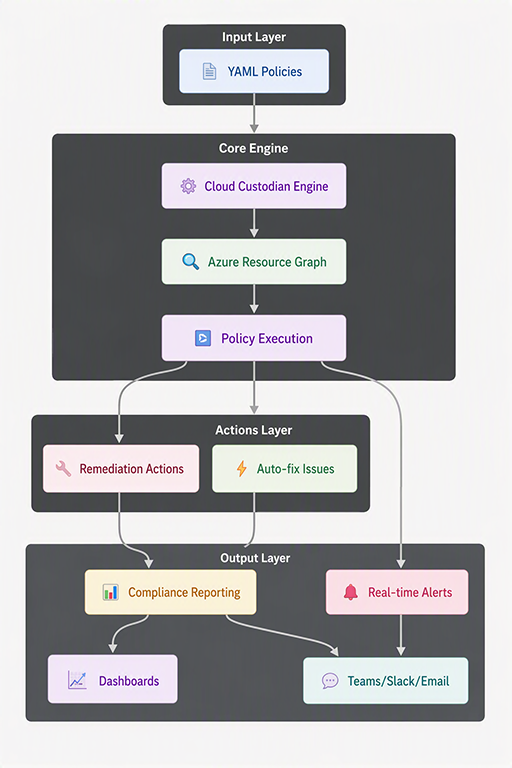
Cloud Custodian directly addresses these challenges by embedding governance into operations. Through its policy-as-code governance framework, security policies, tagging rules, lifecycle actions, and operational controls are codified and executed consistently across accounts, providers, and distributed cloud environments. Compliance becomes automated, scalable, and aligned with enterprise priorities through policy-based automation in cloud computing.
Strategic Importance of Cloud Custodian
Cloud Custodian transforms governance from a reactive compliance burden into a proactive driver of enterprise value. By adopting a policy-as-code governance framework, organizations can:
- Strengthen Security and Compliance: Enforce encryption, detect misconfigurations, and ensure uniform policy application across subscriptions and cloud platforms through automated policy enforcement.
- Optimize Costs: Identify and eliminate unused resources, right-size workloads, and improve financial accountability across enterprise cloud operations.
- Drive Operational Consistency: Standardize governance rules across teams and geographies, reducing risk and accelerating adoption of best practices.
- Enable Scalable Automation: Deploy policies as serverless functions that respond in real time, allowing governance to keep pace with rapid cloud and AI-driven growth.
How Cloud Custodian Works
Cloud Custodian enforces policies that deliver immediate, measurable benefits for security, compliance, and cost control. Tagging policies enforced at provisioning reduce orphaned resources while improving chargeback, ownership visibility, and auditability across enterprise cloud environments.
Automated lifecycle rules remove or quarantine unused resources and stop non-production instances during off-hours. This reduces neglected, internet-facing assets and cuts unnecessary cloud spend across cloud platforms and cloud-native services.
At a functional level, Cloud Custodian enables policy-based automation in cloud computing through:
- Security policies such as IAM least privilege, continuous misconfiguration detection, and mandatory encryption.
- Tagging policies that enforce required metadata to support ownership, audit trails, and cost attribution.
- Resource lifecycle rules that identify and remediate unused resources and stale identities.
- Operational controls that reduce attack surface and cost by automatically managing non-production workloads.
Together, these capabilities embed governance directly into enterprise cloud operations rather than treating it as a separate control layer.
Business Outcomes
Adopting Cloud Custodian delivers measurable outcomes that matter to executive leadership:
- Risk Reduction: Automated detection and remediation minimize exposure to security breaches and compliance violations, ensuring consistent enforcement of security policies across cloud subscriptions.
- Financial Efficiency: Continuous optimization eliminates waste, right-sizes workloads to match demand, and improves predictability of cloud spend, delivering sustained cost savings and improved ROI.
- Enterprise Agility: Governance embedded into operations enables teams to innovate faster, adopt AI workloads confidently, and scale initiatives without sacrificing control.
- Trust and Transparency: Auditable, policy-driven governance strengthens regulatory alignment and reporting frameworks, building confidence with stakeholders and regulators.
Adoption Roadmap
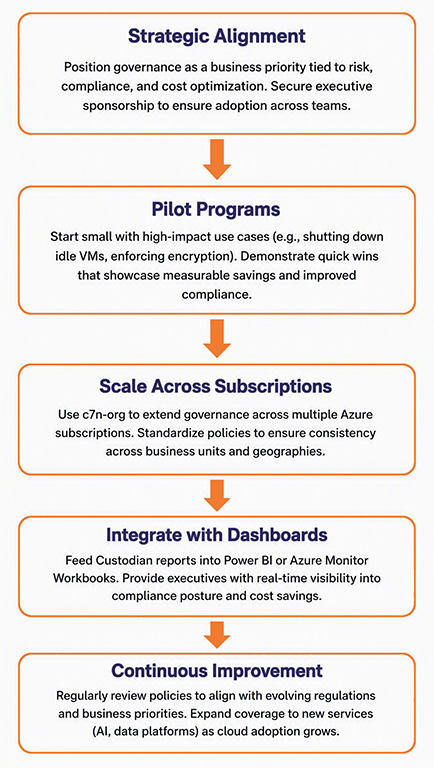
Successful governance transformation requires more than tools; it demands a phased roadmap aligned with business priorities. Cloud Custodian adoption should begin with strategic alignment, followed by targeted pilots and enterprise-wide scaling. This approach ensures governance evolves from isolated technical enforcement into a unified, automated capability embedded across the organization and enterprise cloud environments.
A structured adoption workflow enables consistent policy deployment and enforcement while demonstrating quick wins that build momentum and executive confidence.
From Strategy to Scaled Cloud Governance
The adoption roadmap shows how Cloud Custodian becomes an operating capability rather than a one-time deployment. It starts by aligning governance with business priorities such as risk reduction, compliance confidence, and cost optimization. Organizations then validate value through focused pilot programs that deliver measurable outcomes and build trust across teams. Once proven, policies are scaled consistently across subscriptions, business units, and cloud environments using c7n-org. Governance insights are integrated into executive dashboards to provide real-time visibility into compliance posture and cost savings. Finally, policies are continuously refined to adapt to evolving regulations, AI workloads, and cloud services, ensuring governance remains resilient as cloud adoption grows.
Cloud Custodian Use Cases
Cloud Custodian’s value is best understood through real-world industry challenges. While pressures differ across sectors, the underlying need is consistent: automated governance that scales across cloud environments and platforms.
- Financial Services: Regulatory pressure and uncontrolled cloud spend demand consistent enforcement of encryption, logging, and lifecycle policies integrated into DevOps pipelines.
- Healthcare and Life Sciences: Strict data protection requirements require encryption, tagging, and logging aligned with healthcare data governance and AI governance requirements.
- Retail and Consumer Goods: Seasonal demand benefits from automated lifecycle controls and tagging standards that optimize costs without slowing innovation.
Industries such as manufacturing, telecommunications, government, and technology services can also leverage Cloud Custodian to reduce risk, optimize costs, and accelerate innovation across any cloud platform.
Future Enhancements and Enterprise Enablement
As cloud governance matures, Cloud Custodian can be extended with automation, integration, and visibility to support enterprise-scale adoption and sustained policy-as-code execution.
- Policy Maturity and Security: Deeper enforcement across cost, compliance, and security controls, including cybersecurity and IT security policy enforcement.
- Automation and Integration: Seamless alignment with DevOps and infrastructure-as-code workflows using tools such as Terraform and CI/CD pipelines.
- Visibility and Scale: Executive reporting through Power BI and centralized policy deployment across subscriptions using c7n-org.
Conclusion
Cloud Custodian is more than a governance framework. It is a strategic lever for enterprise resilience, efficiency, and trust. By embedding automated policies into cloud operations, organizations can reduce risk, optimize costs, and accelerate innovation without sacrificing control.
With proven strengths in cloud governance and automation, HTC helps enterprises adopt Cloud Custodian at scale, turning policy-as-code from a technical construct into a durable operating capability. From governance strategy to enterprise-wide rollout, HTC partners with organizations to enable the journey from strategy to scale cloud governance.