



Why Recommendations Matter More Than Ever
A persistent challenge faced by Salesforce sales and service organizations is providing real-time, data-driven guidance for their service agents and sales agents. As a result, critical decisions around cross-sell, prioritization, and customer engagement are often left to individual judgment. This leads to inconsistent outcomes and missed revenue opportunities. In today’s digital enterprises, the gap is no longer data availability but the ability to translate data into actionable decisions within agent workflows.
Contextual and AI-powered recommendations elevate this model by embedding decision intelligence directly into agent workflows. Agents are guided by a combination of business rules and predictive insights, thus systematically improving decision-making and opportunity generation across every interaction. Within the Salesforce ecosystem, this approach enables organizations to operationalize intelligence directly inside business process automation workflows. Interestingly, advanced AI capabilities or perfectly unified data are not required to get started.
In low-frequency, high-value environments such as banking, insurance, B2B commerce, and manufacturing, much of the decision logic and moments of truth are already well understood. A structured, rules-based foundation can deliver immediate impact, with AI models layered in progressively to refine targeting and improve outcomes over time. This reinforces that a Salesforce recommendation engine can start with rules and evolve with AI maturity.
In this blog, I’ll outline a practical, Salesforce-native architecture that allows you to start delivering value quickly while progressively improving capabilities as your data and AI maturity evolve.
We’ll walk through:
- Common business use cases
- What’s unique about the Salesforce ecosystem?
- How to architect your solution?
- Handling explainability for compliance and audits
High-Impact Use Cases
Let’s start with some high-impact use cases. For service agents, the goal is to quickly surface next-best actions on the account that either result in higher revenue or reduce costs.
For example:
- If a customer does not have an online account, agents should recommend sign-up and guide them through digital onboarding (while avoiding repeated prompts within a defined timeframe).
- Cross-sell offers, such as recommending products complementary to those the customer already has, for example, suggesting the right credit card to customers with only a bank account, or recommending auto insurance to customers who already have home insurance (if eligible).
For a sales agent, recommendations should improve prioritization and conversion:
- Providing insights into customer qualification level helps agents prioritize the most likely-to-convert prospects, for example, if specs are complete, the delivery timeline is sooner, or order patterns in the sector/market are matched.
- Providing recommendations on whether an additional discount or bundling may help them close a customer faster. E.g., offering introductory points increases the probability of closing by 20%.
These insights are valuable in improving business outcomes when embedded into sales and service workflows.
The Salesforce Platform Advantage
What makes the approach presented in this blog practical is that the Salesforce platform already provides the building blocks required to deliver contextual recommendations.
Sales and service consoles act as the primary point of engagement and are routinely extended to support business-specific workflows, data capture, and integrations. This extensibility is provided through platform-native capabilities such as Apex, Lightning components, and flows.
More importantly, Salesforce now offers a unified data and analytics layer through Data 360. This allows organizations to bring together data from CRM and external systems, create unified customer profiles, and run predictive models within the same ecosystem. These models can then be accessed in real time from the CRM engagement layer to support agent decisions. This unified capability is a key enabler for building scalable AI-powered recommendations within the Salesforce ecosystem. The platform also provides integrated LLM capabilities with built-in data privacy and governance controls. As capabilities and business needs evolve, the door is open to incorporate advanced AI models that are trained outside.
Together, these capabilities make Salesforce a largely self-contained platform for building and scaling AI-powered recommendation engines without requiring complex, multi-system architectures upfront.
This enables decisioning logic to be embedded directly into the agent experience without rethinking the core system.
A Practical Salesforce Reference Architecture
If you’re with me so far, the architecture is straightforward. We start with the point of engagement, fetch the relevant data from the CRM, apply business and eligibility rules to identify applicable offers, and then invoke the predictive models to tell us the propensity of conversion of the various offers. These offers are then displayed right back on the familiar account and opportunity screens. This flow forms the foundation of a scalable Salesforce recommendations engine, operating seamlessly within business process automation workflows.
The model can be conceptually represented as follows:
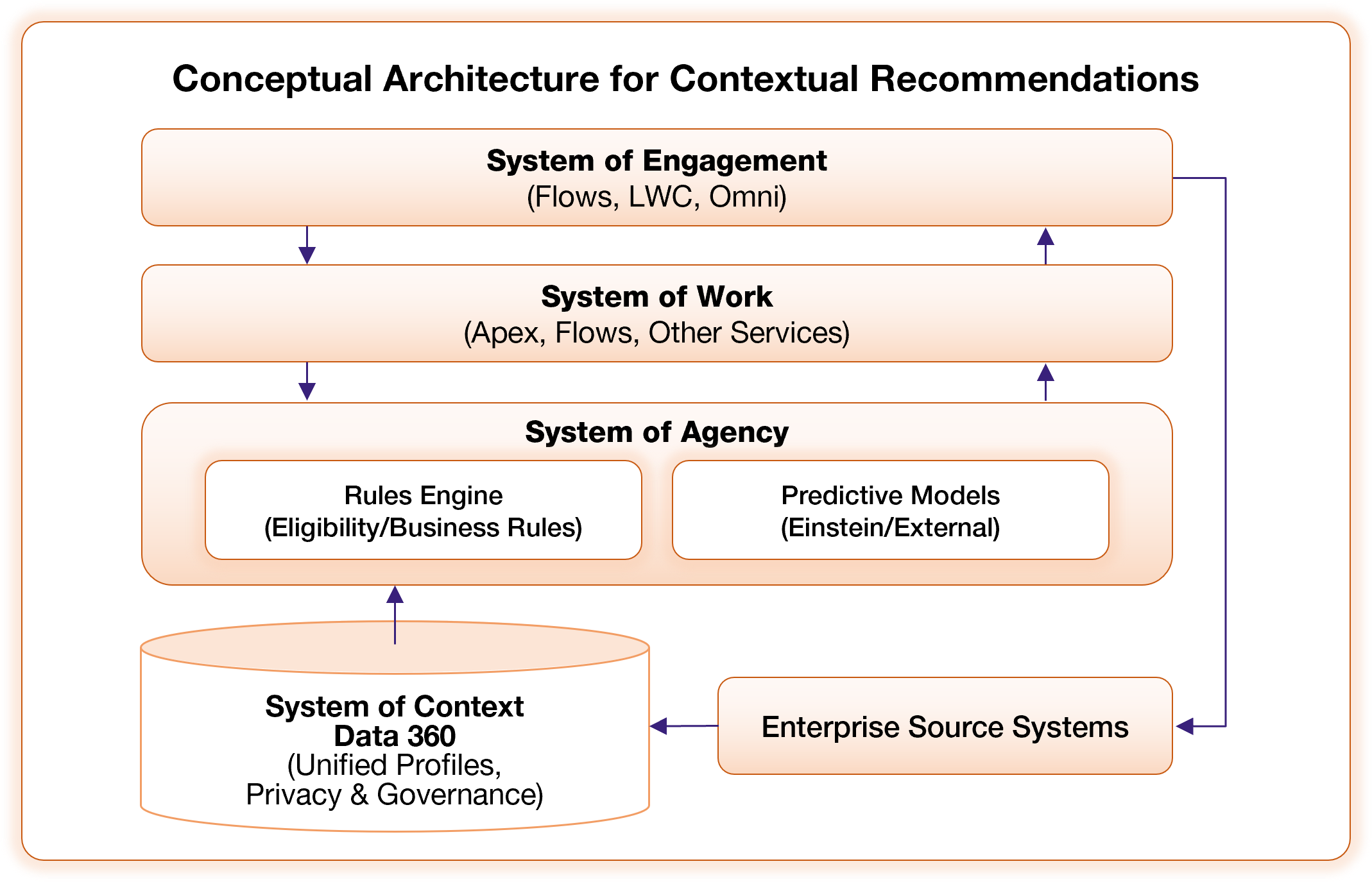
That’s it. You have everything you need right in your Salesforce ecosystem.
Even without fully consolidated data or a mature data science team, this architecture allows you to start without delay. That’s because suggesting a product in low-frequency, high-value environments is intuitive on its own. Using AI models builds on the foundation and improves the targeting, but it’s not a prerequisite for enhancing the effectiveness of your agents. For example, pitching relevant credit card accounts to customers with robust bank accounts, auto insurance to customers with home insurance, or after-sales warranties to customers who buy certain types of products. AI will positively improve and refine this targeting, but it’s not really a requirement to start.
What you need is a scalable architecture that allows plugging in AI models as they are developed. And that’s exactly what this reference architecture above provides.
Built-In Explainability: Compliance Without the Complexity
For any enterprise, especially regulated ones, compliance and audits are critical to plan up front. It is important to be able to explain the outcomes to eliminate the potential for undetected bias.
Luckily for us, the architecture above has explainability built in.
- The rules engine is explainable with respect to the recommendations it surfaces. These are all documented in the code and rules themselves.
- If we use Einstein AI on Data 360, then every call to the model comes back with data about the recommendation’s contribution to the overall propensity and what changing the values of the influencers may result in. For any compliance need, this is valuable information. All of our data used for training is transparent too, and the model training data is transparent as well.
- And finally, if we decide to use the built-in generative AI prompt builder to get back LLM- generated summaries, we can ensure that confidential data is not transmitted to an external LLM engine and that the inputs and outputs are fully logged for subsequent examination.
These capabilities ensure responsible and compliant AI adoption on the Salesforce platform.
Next Steps
Delivering meaningful recommendations on Salesforce is not constrained by technology, AI, or data maturity. Most organizations today are still at rule-based or early predictive stages, and significant value can already be realized at these levels.
You can deliver meaningful performance improvements by:
- Starting with simple, high-impact use cases
- Embedding recommendations into workflows
- Avoiding delays caused by incomplete data or technology readiness
If you’d like to explore implementing a recommendations engine to improve business outcomes, get in touch for a live demo. You can also request a data & technology roadmap recommendation for your specific business process and data landscape.