


Law enforcement uploads eleven body-camera files at the end of an officer’s shift.
The laboratory posts a preliminary result after the next forensic batch is processed.
The court reschedules the hearing days later.
A victim advocate records a new safety concern as soon as it emerges.
Different events. Different timelines. Different systems.
But they all belong to the same case.
The prosecutor’s case management system may know none of it. No single event has failed. The evidence arrived. The laboratory completed its work. The court updated its calendar. The advocate documented the concern.
What failed was the space between them.
That is the technology problem modern prosecution must now solve.
The case file is no longer simply a file. It is a continuous stream of evidence, decisions, deadlines, communications, and external events. Yet many prosecutor case management systems still wait for someone to collect those events, interpret them, and manually update the record.
The future of prosecution will belong to systems that do more than store the case. They must help the case respond.
Prosecution Is Already a Network. Its Technology Is Still a Collection of Islands.
The scale of the U.S. justice ecosystem makes coordination difficult by design.
The FBI received 2025 crime data from more than 17,000 law enforcement agencies, including over 15,000 agencies submitting through the National Incident-Based Reporting System. Separately, the Bureau of Justice Statistics identifies 2,347 state prosecutor offices handling felony cases in courts of general jurisdiction. Those offices employed more than 35,000 attorneys in 2020. [1, 2]
Add courts, crime laboratories, corrections agencies, digital evidence platforms, victim service providers, treatment programs, and federal partners, and a modern prosecution environment quickly becomes one of the most distributed information ecosystems in government.
The technology supporting it, however, often remains application-centric.
Each system performs its own function:
- Law enforcement records the incident.
- A digital evidence platform stores the video.
- A laboratory manages forensic results.
- The court manages hearings and filings.
- The prosecutor’s system manages the case.
Individually, every system may be working exactly as intended.
Collectively, the case can still be fragmented.
The National Institute of Justice has found that the criminal justice community has invested substantially in information-sharing standards but still lacks a comprehensive view of the information-sharing process. Its research also identified gaps involving forensics, analytics, and the exchange of unstructured information such as video, images, and audio. [3]
In other words, the technology can exchange pieces of the case without necessarily coordinating the case itself.
The Case File Has Become an Event Stream
Traditional case management was built around records.
A person.
A charge.
A hearing.
A document.
A disposition.
Modern prosecution still needs all of those records. But it also needs to understand what happens when one of them changes.
A new evidence upload is not merely another file. It may require review, disclosure, redaction, reassignment, or follow-up with law enforcement.
A changed court date is not merely a calendar update. It may affect witness preparation, victim communication, attorney availability, document deadlines, and transportation arrangements.
A laboratory result is not merely an attachment. It may change the strength of the case, trigger additional investigation, or require an immediate legal decision.
The technical difference is significant.
A record tells the system what exists. An event tells the system what just happened.
Coordination begins when the platform can translate that event into the next appropriate action.
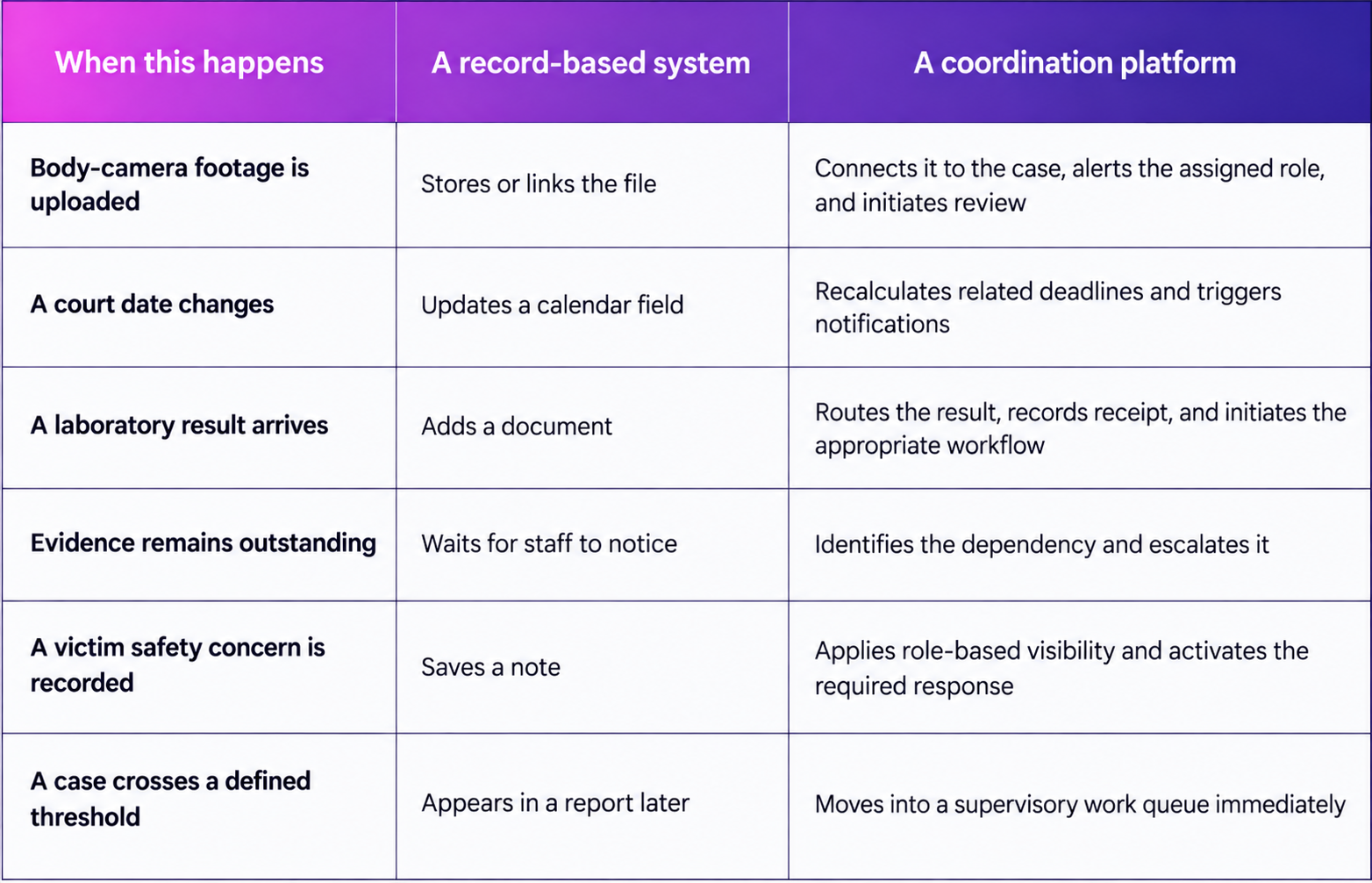
This is the difference between digitizing information and coordinating work.
APIs Open the Door. Orchestration Moves the Case.
APIs are essential to modern justice technology. They allow systems to exchange information without forcing every agency onto the same platform.
But an API alone does not create coordination. It may deliver the laboratory result. It does not determine who should review it. It may transmit the new court date. It does not automatically adjust the surrounding work. It may provide access to body-camera footage. It does not confirm whether the evidence has been reviewed, redacted, disclosed, or followed up.
That requires an orchestration layer. A coordination-ready platform must combine several capabilities:
- Semantic consistency ensures that participating systems understand the information in the same way. The National Information Exchange Model was created specifically to support common meaning and consistent data exchange across agencies and levels of government. [4]
- Identity and access controls determine who may see sensitive information and what actions each role may perform.
- Event-driven workflows turn external changes into tasks, alerts, deadlines, approvals, and escalations.
- Configurable business rules allow each jurisdiction to reflect its own policies without hard-coding every variation.
- Auditability preserves what entered the system, what changed, who acted, and what happened next.
Together, these capabilities allow specialized systems to remain specialized while the case moves through them as one coordinated journey.
Digital Evidence Is the Stress Test
Body-worn camera evidence reveals what happens when coordination does not keep pace with technology.
A Bureau of Justice Assistance survey of 68 federally funded body-worn camera agencies found that their most frequently cited digital evidence management challenges were cost, staffing, and resources at 28%, storage and infrastructure at 25%, and video redaction at 14%. [5]
BJA’s research across seven jurisdictions also examined how body-worn camera evidence flows internally within law enforcement and externally to prosecutor offices. Its findings treat digital evidence management as a cross-system and cross-agency process, not merely a storage problem. [6]
The camera captures the event. The evidence platform stores it. But prosecution depends on everything that follows: association, access, review, disclosure, redaction, tracking, and action.
That is why coordination is becoming the real measure of case management maturity.
Coordination Is Also the Foundation for AI
AI can classify and redact documents well, improve search and find correlations for prosecutors, and assist with administrative work. But an isolated AI tool may simply become another island and, of course, present privacy and sensitivity challenges given the protected nature of the data.
For AI to support prosecution responsibly, it cannot circumvent data privacy, and importantly, it also needs trusted case context:
- Which case does this information belong to?
- Which version is current?
- Who is authorized to access it?
- What policy applies?
- What deadline or workflow does it affect?
- Which actions require human review?
AI becomes operationally valuable when it participates in a coordinated architecture rather than operating outside it.
The journey to AI-enabled prosecution therefore does not begin with a model. It begins with connected, governed, event-aware case management.
When the Case Begins to Move as One
This is the technology vision behind HTC’s CMP NextGen.
CMP NextGen is a cloud-native, API-first prosecutor case management platform designed to bring case information, digital evidence, documents, workflows, analytics, and justice-system integrations into one coordinated operational environment.
Its configurable workflows help translate office policies into consistent case movement. Role-based work queues direct attention to what requires action. API-led connectivity supports information exchange with law enforcement, courts, evidence systems, laboratories, and other justice partners. Integrated audit trails preserve visibility across the case lifecycle.
The goal is not to build one enormous system that replaces every specialized platform.
It is to create an intelligent coordination layer that allows those platforms to contribute to one current, actionable understanding of the case.
The next breakthrough in prosecution technology will not be another screen, database, or isolated application.
It will be the moment the case begins to react as one system, even though it moves through many.
That is the future of prosecution. And it must be coordinated by design.
References
- Federal Bureau of Investigation, “FBI Releases Historic Early Look at Annual Crime Data,” May 13, 2026.
- Bureau of Justice Statistics, “Prosecutors in State Courts, 2020,” November 2024.
- National Institute of Justice, “Creating a Framework for Criminal Justice Information Sharing,” March 2018.
- Bureau of Justice Assistance, “National Information Exchange Model (NIEM).”
- Bureau of Justice Assistance, “An Examination of Body-Worn Camera Digital Evidence Management Strategies,” March 2022.
- Bureau of Justice Assistance, “Managing Digital Evidence from Body-Worn Cameras: Case Studies in Seven Sites,” March 2022.