

Walk into a modern retail store, and you’ll see multiple decisions being made: every minute, when to discount perishable items, how to reconcile inventory with what’s on the shelf, which products to promote, and how to ensure compliance for sensitive materials. Each of these decisions directly impacts margins, customer experience, and operational risk. Traditionally, they’ve been driven by a combination of experience, manual processes, and limited visibility, leaving room for inefficiencies and missed opportunities. Retail has long operated at the intersection of precision and guesswork.
Today, retailers are also navigating rising customer expectations, omnichannel buying behavior, labor pressures, and increasing demand for real-time operational visibility. Traditional retail operations were never designed for this level of speed and complexity, making retail digital transformation a business imperative rather than a future initiative.
That balance is now shifting quietly but decisively through the combined power of AI and IoT.
What makes this transformation compelling isn’t just the technology itself, but how effectively it addresses everyday retail challenges. Not in a futuristic or over-engineered way, but in ways that genuinely simplify operations and improve experiences for both customers and store teams.
Let’s look at a few simple, relatable examples.
Smarter Decisions on Perishables With Less Waste
Managing perishable goods has always required careful judgment. Discount too early, and margins suffer; act too late, and products go to waste.
AI and IoT bring much-needed precision to this balancing act.
Sensors continuously monitor storage conditions such as temperature and humidity, while AI models use this data to predict actual shelf life far more accurately than static expiry labels.
This enables retailers to:
- Apply timely, data-driven discounts
- Optimize stock movement and replenishment
- Redirect near-expiry goods for donation or CSR initiatives
The outcome is not just operational efficiency, but also a more sustainable and responsible retail model.
This is where smart retail technology begins creating measurable impact, reducing waste, improving sell-through rates, and enabling stores to make faster, data-driven decisions at scale.
Inventory Audits, Without the Disruption
Inventory audits have traditionally been labor-intensive, time-consuming, and prone to error.
AI is transforming this process through computer vision and automated monitoring.
With intelligent scanning systems, retailers can:
- Continuously monitor shelf stock
- Detect missing, misplaced, or low-stock items
- Maintain near real-time inventory accuracy
This shifts inventory management from periodic checks to continuous visibility. For store teams, it reduces manual effort; for customers, it minimizes the chances of encountering empty shelves.
Combined with smart shelves and real-time inventory tracking, AI-powered monitoring enables stores to maintain significantly higher inventory accuracy with far less manual intervention. Instead of reacting to inventory gaps after they occur, retailers can proactively address issues before they impact the retail experience.
Promotions That Actually Work
Promotions have always been central to retail, but not always effective.
Historically, discounts were driven by broad assumptions or past trends. Today, AI in retail and IoT-enabled systems allow retailers to create far more precise and dynamic promotional strategies. For example:
- Slow-moving products can trigger targeted discounts
- High-demand items can be priced optimally rather than over-discounted
- Customers receive personalized offers based on real behavior and preferences
- Festive season sales can be targeted to the right customer segments
This evolution turns promotions from reactive tactics into thoughtful, data-driven decisions, improving both customer engagement and margin control.
AI-driven customer behavior analytics also help retailers personalize promotions across physical and digital channels, creating a more connected omnichannel retail experience. Predictive analytics models can identify shopping patterns, forecast demand fluctuations, and recommend promotional strategies that improve conversion while protecting margins.
Tracing & Compliance for Hazardous Goods with IoT
IoT-enabled solutions are redefining retail audits of hazardous goods by shifting from manual methods to connected, application-driven processes. Managing hazardous goods across retail stores and warehouses demands strict compliance with safety and regulatory standards. With IoT-based tracking using RFID tags, smart labels, BLE beacons, GPS trackers, and connected sensors, retailers gain real-time visibility into the precise location and movement of these goods.
This transformation enables continuous visibility, automated reconciliation, and precise tracking of serialized inventory through barcode scanning, mobile devices, and IoT gateways.
AI-powered insights can assess this data to ensure regulatory compliance and instantly detect any anomalies. Automated alerts, geofencing triggers, and digital audit trails empower teams to act quickly and maintain inspection-ready records.
This approach significantly minimizes compliance risks while strengthening safety, accountability, and operational transparency.
With edge computing in retail, many compliance checks and monitoring decisions are now executed closer to the store environment through edge devices and smart hubs. This reduces latency, enhances responsiveness, and enables intelligent retail systems to address operational risks more proactively.
Building Intelligent Retail Systems
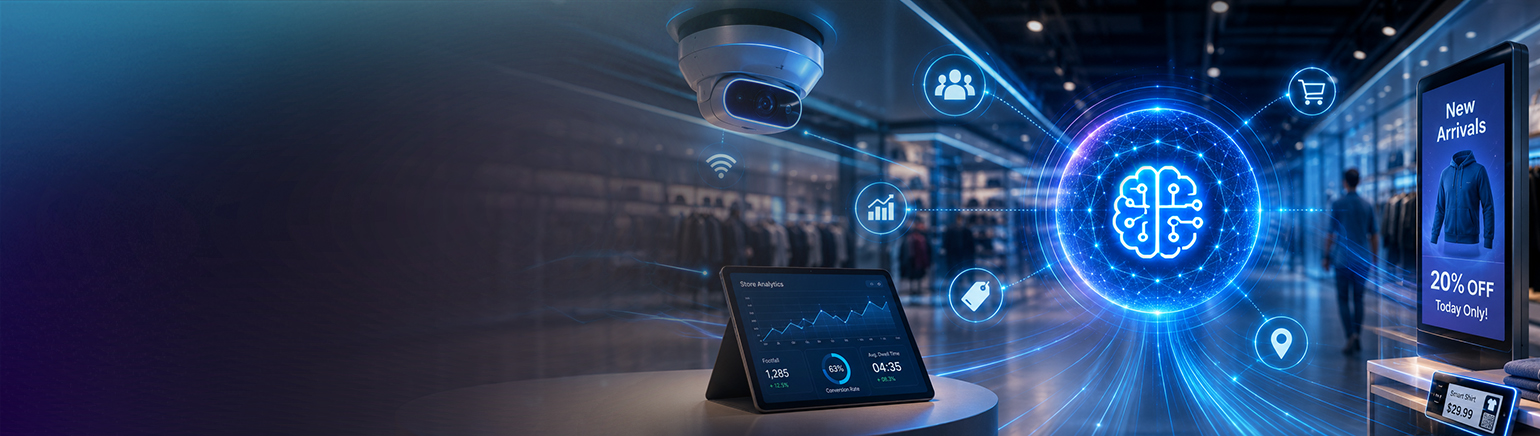
What makes AI and IoT in retail especially powerful is not just individual use cases, but how these technologies work together as connected ecosystems. Modern retail stores are increasingly operating through intelligent retail systems where sensors, smart shelves, AI models, edge devices, and cloud platforms continuously exchange data in real time.
This connected approach enables retailers to move beyond isolated automation into fully responsive store operations. Whether monitoring inventory levels, analyzing customer movement, detecting operational anomalies, or optimizing promotions, smart store technology enables decisions to happen continuously rather than periodically.
This is also changing what smart retail really means. It is no longer limited to digital storefronts or ecommerce experiences. Instead, smart retail technology is creating stores that are more aware, adaptive, and capable of responding dynamically to changing business conditions and customer expectations.
The Next Phase of Smart Retail Technology
As retail operations continue to evolve, AI and IoT will play an even greater role in enabling frictionless and intelligent experiences. From cashierless stores and autonomous inventory monitoring to AI-powered fulfillment and predictive store operations, the retail industry is steadily moving toward real-time, self-optimizing environments.
Retailers are also exploring new IoT applications in retail that combine computer vision, automation, and edge intelligence to improve efficiency while creating more seamless customer interactions. The focus is no longer just on operational efficiency. It is about building retail environments that are responsive, connected, and capable of learning continuously.
From Possibility to Reality in Retail
At a deeper level, AI and IoT are helping retail move from:
- Guesswork to informed decision-making
- Periodic checks to continuous awareness
- Standardized experiences to personalization at scale
More importantly, retail is becoming more responsive, more aware, and ultimately more human.
AI and IoT in retail aren’t about flashy innovation or replacing people. They’re about removing friction, reducing waste, and enabling stores to function the way they always should have, ushering in a more intelligent retail experience.
How HTC Helps Retailers Move Toward Smarter Store Operations
At HTC Global Services, we work with retailers navigating these challenges as operational realities today, not future possibilities. The conversations we have are less about whether to adopt AI and IoT and more about how to connect them meaningfully — so that inventory, promotions, compliance, and customer experience work as a single, intelligent system rather than isolated tools.
What we’ve seen is that retailers making the most progress aren’t necessarily the ones investing most heavily in technology. They’re the ones being deliberate about where connected intelligence removes friction and creates measurable value. That’s the thinking we bring to every engagement — from real-time inventory tracking and computer vision to predictive analytics and intelligent compliance workflows.
As retail continues to evolve, our focus remains on helping businesses build operations that are more adaptive, more visible, and better positioned to grow — without losing the human side of the experience that makes retail work in the first place.