



If you’d asked a prosecutor in 2010 to describe their job in one sentence, they probably could have. Take in a case, build it, take it to trial or a plea, close it, move to the next one. Ask that same question today, and the answer takes a lot longer to give, not because the job got harder in some abstract sense, but because it genuinely got bigger. More pathways a case can take. More data an office is expected to produce. More evidence attached to nearly everything that comes through the door.
Here’s the part that doesn’t get said enough: the system underneath most of that work hasn’t gotten bigger with it. A lot of prosecutor case management platforms were built, or last meaningfully rebuilt, around that old one-sentence answer. One pathway. One workflow. One internal audience. That’s a fine design for the job as it existed in 2010. It’s a real constraint on the job as it exists now.
Laid side by side, the shift is stark:
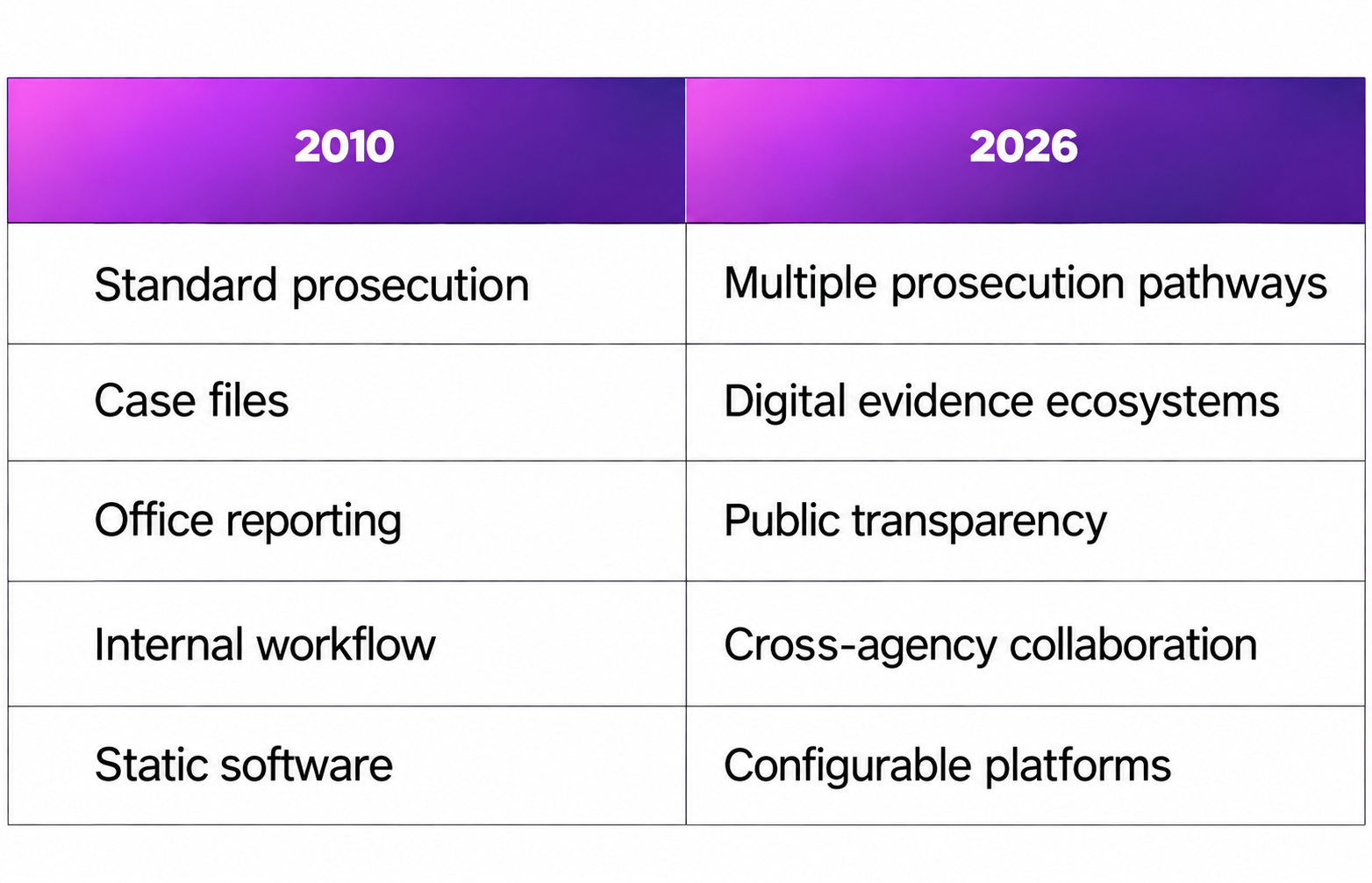
Every row on the right side of that table is now a baseline expectation, not an emerging trend. Every row on the left is what most legacy systems were actually built for.
Prosecution in 2026 Isn’t One Track. It’s Many.
Diversion is no longer a side program. All Rise, the national organization known for decades as the National Association of Drug Court Professionals, traces the movement back to the first twelve drug courts founded in the early 1990s; today it counts more than 3,000 drug courts operating across all 50 states and U.S. territories. That growth is only part of the picture: Nevada’s Administrative Office of the Courts currently funds 84 separate specialty court programs across a single state, spanning drug treatment, DUI, veterans treatment, mental health, family treatment, and half a dozen other tracks, each with its own eligibility rules, milestones, and reporting requirements. Some states have gone further still, making diversion the presumptive outcome for entire categories of offense rather than a discretionary exception.
Every one of those pathways runs on a different set of rules than a standard prosecution. Different eligibility criteria. Different milestones to track. Different partners to coordinate with, from treatment providers to community organizations to specialty court staff. As jurisdictions keep expanding who qualifies and how many pathways exist, the operational lift grows with it: more cases to screen for eligibility, more participants to monitor, more frequent updates for stakeholders and leadership, all layered on top of the traditional caseload.
A system built around a single linear case type doesn’t bend easily to accommodate that. It gets forced to, usually through manual workarounds, side spreadsheets, and processes that live in a coordinator’s head rather than in the platform of record.
Can your current system:
- Add a new diversion program without custom development?
- Track eligibility and milestones for a specialty court docket the same way it tracks a standard case?
- Let a coordinator see participant status without checking a separate spreadsheet?
If the honest answer to any of those is no, that’s not a training gap. It’s a platform gap.
Prosecution in 2026 Runs on Data, Not Just Case Outcomes
The second shift is just as structural. A generation of elected prosecutors has built platforms around transparency and accountability, campaigning specifically on the promise to collect and publish data on how their offices operate, not just on case outcomes. The Brooklyn District Attorney’s Office, for example, made building the internal data infrastructure to monitor safety, incarceration, and equity outcomes a formal, funded initiative precisely because that capability wasn’t already built into the office’s existing systems.
That expectation isn’t limited to reform-minded offices. At the federal level, the Department of Justice’s own analytics team completed more than 2,000 data requests and referred over 160 proactive matters in 2025 alone, using data patterns to drive charging decisions rather than waiting for cases to arrive one at a time. Data-driven prosecution has gone from a progressive talking point to a mainstream operational expectation, regardless of an office’s politics.
Legacy systems were not built with any of this in mind. Many were designed to record what happened on a case, not to make that information queryable, comparable across cases, or presentable to a supervisor, a legislature, or the public.
Can your current system:
- Produce a public-facing dashboard without a manual export and rebuild?
- Show a supervisor real-time caseload and outcome data, not last quarter’s numbers?
- Give two different people the same answer when they pull the same report?
Prosecution in 2026 Runs on More Evidence Than Ever
The third shift is the most visible one, and it’s compounding fast. In one Colorado district, prosecutors handled more than 36,000 videos, roughly 24,000 hours of footage, in 2022. By 2025, that had climbed to more than 67,700 videos totaling 41,000 hours. A routine vehicular homicide case in that same jurisdiction now generates 362 photographs, up from 79 in 2017, along with as much as 90 hours of body-worn and dashcam footage, compared to essentially none eight years earlier.
That volume isn’t coming from one source anymore, either. A single case can now involve body-worn camera footage, dashcam video, home security and license-plate-reader footage, cell tower records, phone extractions, and social media, often several of those stacked on top of each other. The shift has been significant enough that 70 percent of agencies have already moved to cloud-based digital evidence management just to keep pace, a move the industry describes as evidence going from a supporting role to the actual foundation of casework.
Systems built to store a police report and a handful of photos were never sized for that kind of volume, format diversity, or velocity, and it shows in how much manual handling still surrounds digital evidence in offices running older platforms.
Can your current system:
- Ingest video and digital evidence in the formats it actually arrives in, without manual conversion?
- Connect directly to the evidence platforms law enforcement already uses, instead of relying on physical transfers or email?
The System Underneath Wasn’t Built for Any of This
This is where the age of the platform stops being a background detail and starts being the actual constraint. Legacy case management systems are, by design, slow to reconfigure and rarely capable of the reporting modern offices now need. Prosecutor offices in states with more current technology can build data dashboards relatively easily; offices running older systems more often simply don’t have the tools to aggregate and visualize that same information, no matter how badly they need it.
The result is familiar to almost anyone who has worked inside one of these offices: reporting gets rebuilt by hand, every time, from scratch. One county justice agency managing just over 200 program participants found its staff spending nearly 15 hours a week manually preparing reports before modernizing its systems; after adopting a modern dashboard platform, that dropped to under two hours a week. Multiply that gap across every specialty docket, every diversion track, and every request from leadership or the public, and the hours add up fast, hours that were never supposed to be the job in the first place.
Rigid, hard-coded systems also make it difficult to simply add a new case type or program. Standing up a new diversion track or specialty docket often means working around the system rather than through it, because reconfiguring the platform itself requires vendor involvement, custom development, or workarounds that live outside the system of record entirely.
Can your current system:
- Connect directly with law enforcement, court, and evidence platforms, or does data still move by email and manual upload?
- Adapt when a new law, sentencing reform, or reporting mandate changes what your office has to track?
- Stand up a new workflow in days rather than months?
Something Has to Give, and Right Now It’s Consistency
When a system can’t natively support the case types an office is running or the reporting it’s expected to produce, that gap doesn’t close on its own. It gets absorbed, usually by whoever is closest to the work.
It shows up as a diversion coordinator tracking participant milestones in a personal spreadsheet because the case management system has no concept of a diversion track. It shows up as a supervisor spending an afternoon before every leadership meeting manually pulling numbers from three different sources to build one slide. It shows up as public data requests that take weeks to fulfill, not because the office lacks the data, but because the data lives in formats and places that were never meant to be aggregated. And it shows up as inconsistency: two people compiling the “same” report from the same underlying cases and arriving at two different numbers, because there was never one system of record telling them which one was right.
None of that is a failure of effort. It’s what happens when the operating model underneath an office is still built for 2010’s version of the job.
Flexibility Is the Feature Legacy Systems Were Never Built With
Modern, cloud-native case management platforms solve this differently than legacy systems ever could, not by adding more spreadsheets or more manual reporting cycles, but by being built to flex. Configurable workflows that can represent a diversion track, a specialty court docket, or a standard prosecution without custom development. Built-in reporting and dashboards that pull directly from the system of record instead of requiring someone to reconstruct it by hand. A single source of truth that a supervisor, a coordinator, and a public records request can all draw from and get the same answer.
That flexibility isn’t a nice-to-have anymore. It’s the baseline requirement for an office that runs a dozen different pathways and is expected to be transparent about all of them.
Built for the Office Prosecution Has Actually Become
This is the gap HTC’s CMP NextGen was built to close. It’s a cloud-native, API-first case management platform designed to represent the full range of pathways a modern prosecutor’s office actually runs, standard prosecution, diversion programs, and specialty court tracks alike, inside one configurable system rather than a patchwork of workarounds.
CMP NextGen gives supervisors real-time dashboards and reporting built directly from case data, not rebuilt by hand before every meeting, and gives offices the ability to stand up a new program or track without waiting on a vendor customization cycle. It’s built by a team with decades of experience inside prosecutor offices, designed for the operational reality those offices are managing today, not the single-track model most legacy systems were built around.
Diversion, specialty courts, and public accountability are not passing trends. They are what modern prosecution looks like now, and they deserve a system built to support them as a first-class part of the job, not an exception the platform has to be worked around.
CMP NextGen. Case Management for Prosecutors. Reimagined.
References
- MATCP, “National Resources,” citing All Rise (formerly the National Association of Drug Court Professionals).
- Nevada Administrative Office of the Courts, “Specialty Court Program Overview,” 2026.
- The Sentencing Project, “Protect and Redirect: America’s Growing Movement to Divert Youth Out of the Justice System,” March 2025.
- Catalis, “Scalable Diversion Case Management Systems Explained,” June 2026.
- Loyola University Chicago Center for Criminal Justice, “Prosecutorial Performance Indicators.”
- CUNY Institute for State & Local Governance, “Case Study: Brooklyn District Attorney, Data and Transparency.”
- Foley & Lardner, “The Data-Driven Prosecutor: How DOJ’s Analytics Revolution Is Reshaping Fraud Enforcement,” June 2026.
- CivicEye, “Actionable Data: Enhanced Prosecution with Case Management Systems.”
- Aguardion, “From Spreadsheets to Dashboards: Modernizing Justice Case Management,” October 2025.
- CPR News, “Way too much body camera footage: police, prosecutors and defense attorneys struggle with loads of digital evidence,” January 2026.
- Axon, “2026 Digital Evidence Trends Report,” February 2026.
FAQs
1. Why don’t legacy prosecutor case management systems support diversion and specialty court programs well?
Most legacy systems were built around a single, linear prosecution workflow. Diversion programs and specialty courts run on different eligibility rules, milestones, and partners, which older platforms typically can’t represent without manual workarounds or costly custom development.
2. How much has diversion and specialty court activity grown?
The drug court movement alone has grown from its first twelve programs in the early 1990s to more than 3,000 operating across all 50 states and U.S. territories today, and many states now run dozens of additional specialty dockets beyond drug courts, from veterans treatment to mental health to family treatment.
3. Why are prosecutor offices under more pressure to produce data and reporting than before?
A growing number of elected prosecutors have campaigned on transparency and data-driven accountability, and federal enforcement agencies increasingly use data analytics to guide decisions, both of which raise the baseline expectation for what an office’s systems need to produce.
4. What happens when a case management system can’t generate the reporting an office needs?
Staff end up rebuilding reports manually from scattered spreadsheets and separate systems, a process that can consume more than a dozen hours a week and often produces inconsistent numbers depending on who compiles it.
5. What does a modern, flexible case management platform look like?
It’s typically cloud-native and configurable, able to represent multiple case types and program tracks without custom development, and includes built-in dashboards and reporting drawn directly from the system of record.
6. How does CMP NextGen help offices manage diverse case types and reporting demands?
CMP NextGen is built to represent standard prosecution, diversion programs, and specialty court tracks within one configurable system, with real-time dashboards and reporting that pull directly from case data instead of requiring manual reconstruction.
7. Can legacy case management systems handle modern digital evidence volumes?
Not well. Video and evidence volumes have nearly doubled in some jurisdictions in just a few years, and a single case can now draw on body-worn cameras, dashcams, phone extractions, and social media at once. Systems built to store a police report and a handful of photos typically can’t ingest that volume or format diversity without manual conversion and workarounds outside the system of record.